 Club
News Club
News
Our Ecolodge Members
We warmly thank the Boat Landing Guesthouse
(Laos) http://ecoclub.com/theboatlanding
and Bathurst Inlet Lodge (Canada)
http://ecoclub.com/bathurstinlet
for renewing as Ecolodge Members.
We also welcome El Nagual (Brazil)
http://ecoclub.com/elnagual
and
The Pimenta (India) http://ecoclub.com/thepimenta
as new Ecolodge Members.
Our Expert Members
We warmly thank the following Ecotourism
Experts for renewing Expert Membership:
Dr Arturo Sandoval (Mexico)
Professor Aimilia Drougas (Greece)
Ms Rachel Dodds (UK)
Dr Eriks Leitis (Latvia)
Professor Todd Comen (USA)
Mr Andre Dukhia (Guyana)
Mr Jerry A-Kum (Surinam)
Mr Nick Polychronidis (Greece)
Mr Stephen Mak (China, Hong Kong SAR)
and welcome our new Expert
Ms Debra Scisco (USA)
All our Experts provide a free basic
consultancy in their particular geographic and thematic area
of expertise to ecotourism businesses, please contact them at:
http://ecoclub.com/experts.html
|
Letters
to the Editor
Think Locally
"I'd like to reply to the letter of Mr. Vinzenz Schmack,
which appeared in the previous issue. The advice that the
local community gave to Mr. Schmack , to cut the trees and
plant pineapples, was good advice, kindly meant. It was the
best thing they could think of for you to do to prosper, since
no one had shown them viable ecotourism. Had they been
informed, they might have set up traditional hospitality and
guiding for their own benefit. As for the locals having
"no education", they often are far better informed
about the locality than any incomer and are quite able to
understand profit and loss, not only monetary. And as for
wanting quick profits on investments - they almost certainly
are capable of understanding waiting for a harvest to ripen,
whether it is vegetal or developmental. For generations nature
conservation areas like national parks tended to be formed for
the benefit of the animals to the detriment of any human being
around. In South Africa people were moved out of places like
the Kruger National Park and if they tried to pursue their
traditional hunting way of life in their traditional hunting
grounds, they became poachers and were sent to prison. They
often were left with unproductive land while governments and
private owners made money out of the tourists who visited.
With the change in philosophy in South Africa, which was
espoused by many private game lodge owners before democracy,
the policy is to involve the neighbouring communities. At
Kruger, the villages on the margins of the park not only
supply staff but have rights to conduct craft markets at the
park gates and to cut grass in the park for roofing and
basket-making. All of this is regarded as social investment
with returns in good neighbours, happy staff and supporters in
the region. Here land is being returned to people who were
dispossessed by previous governments. Some of the new owners
have decided to turn their ancestral grazing and hunting lands
into eco-tourism concerns, and hire experienced management. If
this happens in Costa Rica at some time in the future, will
the forest dwellers hesitate to claim back a private
lodge?"
Anne Taylor, Cape Town
Editor comments: Beyond the issue of
whether the "local people" are able or not to decide
for themselves (indeed they are, saying that they are not is
undemocratic), I believe the heart of the issue has to do with
national laws and the political-economic system of a country.
Ideally, we all have to obey the same laws. 1. If the local
law permits private ownership of the rainforest, then by
definition the private owners are not legally required to
consult with the neighbouring community. (They can choose to
ignore the community, at their own peril - forests are
flammable). If the citizens are happy with that law, fine, if
not they should change it through legal means 2. If there are
no laws that prevent the private owner of a forest from
cutting down the trees, then by definition he is not legally
required to preserve the trees. Others may not like this, but
the best solution again is to try and change the law, rather
than to confront those who are legally exploiting a natural
resource. 3. With the exception of few remaining "uncontacted
peoples", the "local people" of the so-called
developing world, are no more "benevolent", naive,
or ignorant, than outsiders coming to invest in their
neighborhood. They are simply poorer. In general, true
democracy requires clear, fair, laws, voted by all &
universally applied, rather than voluntary "codes of
ethics" decided by stakeholders", although in
practice "codes of ethics" are usually the first
step towards legislation, good or bad.
Timeo Danaos
"I read the Interview with Megan Epler Wood and the TIES,
founded in 1990. It occurred to me, however, that a whole,
generation, may I say 'era', of creation and struggle, of
successes and disappointments, of victories and defeats, was
disregarded, long before the foundations and corporations
started loosening their purse strings. We may all have the
same goals, but it is much harder, although a lot more
truthful, to carry on the green struggle without the
"green" the establishment finally decided to lavish
on those ecotourism outfits that were willing to accept it.
Some of us were not willing to be too closely associated with
entities such as government agencies, world banks, private
foundations, and many others who attached hidden strings to
their participation, explicitly or implicitly. Perhaps at that
time the ratio of realistic idealism to calculated venality
was much higher than it is now, especially taking into
consideration the fear of "the Americans bringing
gifts", which was not totally unfounded: a repeat of the
old "timeo Danaos et dona ferentes".
Dr. Franco Ferrari, Forum International, Pleasant Hill,
California
|

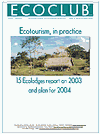
 One
year after the end of the International Year of Ecotourism, the
spotlights are gone, but those that really care and practice
ecotourism every day are still at it. So, in this issue instead of
abstract theories about "the future which is unknown" we let
them speak: In lieu of the regular interview you will find some
first-hand reports on the achievements, struggles and future plans of
fifteen of our Ecolodge Members. On our part we promise to keep trying
to improve the ECOCLUB magazine and our club membership benefits, we
look forward to your continued interest and participation, and wish
you all a prosperous and peaceful 2004.
One
year after the end of the International Year of Ecotourism, the
spotlights are gone, but those that really care and practice
ecotourism every day are still at it. So, in this issue instead of
abstract theories about "the future which is unknown" we let
them speak: In lieu of the regular interview you will find some
first-hand reports on the achievements, struggles and future plans of
fifteen of our Ecolodge Members. On our part we promise to keep trying
to improve the ECOCLUB magazine and our club membership benefits, we
look forward to your continued interest and participation, and wish
you all a prosperous and peaceful 2004.
