|
 Whitewater
Rafting - A Sustainable Future Whitewater
Rafting - A Sustainable Future
by Debra Scisco*
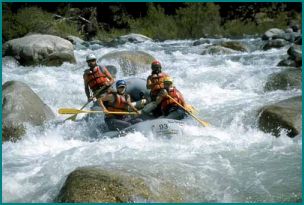
Whitewater rafting, as an industry, has many
opportunities to contribute to the conservation of the natural
environment and the sustainability of the local communities:
 An
alternative to other forms of employment or industry An
alternative to other forms of employment or industry
Establishing whitewater raft tourism into a community gives the local
persons an alternative to other industries and employment that could
be harmful to the environment. Ecologically friendly employment can
include river guides as well as Ecolodge staff. In Costa Rica, the
significant rise of tourism and creation of nationally protected parks
and areas has led to tourism becoming the second largest industry in
the country and services containing 58% of the labor force in 1999.The
slash and burn tactics and deforestation of the country's natural
resources have become almost non-existent.
Contributions to the local community
Contributions to the community can be in the form of direct
contributions or governmental charges. Fees could be charged for the
use of certain sections of a river, entrance to a national park or
conservation activities. The government may enforce other fees such as
user fees, permits, taxes on sales or rentals of whitewater raft
equipment and licenses for the company to operate. These monies can be
allocated to the community to pay for the protection of their natural
environment as well as for improving community and tourism facilities.
For example: "In West Virginia a whitewater rafting tax is
collected from everyone who participates in a commercial rafting trip.
The fee goes toward studying the environmental impacts of rafting. In
addition, the rafting companies participate in several river cleanup
days each year, according to the Environmental Protection Agency.
Maintain cultural values
Whitewater raft companies can help the local community to sustain
their cultural values by designing their tours and their Ecolodges to
be a "cultural" experience. Local community members use
their skills and trade as part of the tour. The company could even
involve the community leaders in the management of the company to
ensure cultural values are attained. In Fiji, one whitewater raft
company selects guides "by a cooperative consisting of village
elders, traditional landowners and company management. This method
ensures that cultural and sociological decision making processes are
maintained and supported" (Don Morberg, 2002). These practices
will be far more likely to result in positive support for whitewater
raft tourism from the local communities as well.
Use of Ecolodges for overnight trips
For multi-day trips the use of an Ecolodge for the overnight stay in
place of camping on the riverbank has many advantages. It minimises
the impact on the environment in that it is an established location,
waste is contained, and the wildlife is less disturbed. As a former
whitewater guide, this author is familiar with how difficult it is to
enforce environmental practices on tourists. It creates employment for
the local community and can be an educational and cultural experience
for the ecotourist as well. Several raft companies in Central America
have been very successful using the Ecolodge as part of their tours
and have gone as far as to make it their main attraction.
Enforce controls on the number of tourists per
region
Raft companies can offset the negative impacts of tourism by enforcing
controls on the number of tourists and tours per day on each section
of the river. This enforcement would require cooperation between the
competing raft companies; therefore the state and/or federal
government usually enforce the regulations. In Utah and Arizona,
certain sections of the Colorado River are protected by regulatory
measures in the form of permits. The Grand Canyon, with "a
waiting list of over 600 names means you could wait for more than 8
years for your name to come to the top of the list" (River
Permits and Info Grand Canyon National Park, 2003). Although it may be
difficult or take years to obtain these permits, they help to reduce
the negative impacts on natural resources and wildlife. These
regulations make the trip more aesthetically pleasing as well because
the tour does not have to be shared with a multitude of other boats
and companies.
 About
the Author: Ms. Debra Scisco is the principle
consultant for EcoSupport About
the Author: Ms. Debra Scisco is the principle
consultant for EcoSupport
(http://www.ecosupport.net).
Contact Ms Scisco at: http://ecoclub.com/experts/scisco.html
Cultural
Tourism in Nigeria:
Reply to an Enquiry by Samuel Segun Odunlami*
Cultural tourism involves tourism based on beliefs
and religion and Nigeria been a country with over 350 ethnic groups
with unique beliefs and customs, is very rich in diverse cultures and
festivals. In fact there is hardly any week in Nigeria without a
festival. In this context, the Nigerian Tourism Development
Corporation (NTDC) has identified cultural Tourism as very important
to realising tourism development in the country and has recently come
up with a "cultural tourism calendar" for the country. The
major festivals have been carefully chosen for promotion and
development. This is to allow for the development of other events that
will later on be developed and adequately promoted. The major
festivals that are currently given priority include the Osun Oshogbo
Festival in Osun State, Durbar Festivals in most states of the North,
Mmanwu Yam Festival in Enugu, Eyo Festival in Lagos and Argungu
Fishing Festival. Others include Ovia Osese in Kogi State, Ikeji
Festival in Imo State and the Boat Regata in the Riverine areas.
Concerning the issue of Ecotourism and Cultural
Tourism, the fact remains that cultural tourism is more popular among
Nigerians. Many will go back to their villages from the cities either
to participate or witness these cultural events. It is more popular
than ecotourism and better perceived than ecotourism. But it is also a
fact that many tour operators usually include a tour to a national
park in their itinerary. Also, tours to any of the national parks
always include the use of the local cultural display to entertain
visitors, especially foreign tourists. From my personal experience as
a trainer in the industry, the two go hand in hand and should be
coordinated.
Until now only a few Nigerians have really taken
the initiative to invest in tourism, as it would require a reasonable
sum of capital investment. Many also complain to us that the
government has not provided enough infrastructures for serious tourism
development so that private investors would be attracted. Besides the
era of Obasanjo administration in the early seventies, none of the
governments that followed showed any serious commitment to the
development of the industry as they were all more interested in oil
extraction. Another important factor has to do with domestic
awareness, as many Nigerians simply do not know where some of these
attractions are located. With respect to Cultural Tourism, many who
would have loved to experience these unique events can find little
information about where and when celebrations are held. Hopefully the
NTDC calendar for Cultural Festivals can address some of these issues.
Not all is bleak, though. There is indeed a steady
growth in the number of domestic tourists visiting the tourist
attraction sites in Nigeria. What is even most interesting is the fact
that majority of these visit the Nigeria national parks, especially
the Yankari, Old Oyo and kainji- Lake national parks which are
recording an unprecedented number of Nigerians every weekend, although
of course few of these visitors can be classified as ecotourists. It
is just that the national parks are the most developed tourist
destinations in the country.
About
the Author: Mr Samuel Segun Odunlami is Senior
Lecturer at the National Institute for Hospitality & Tourism
Studies in Kano, Nigeria. Contact Mr. Odunlami at http://ecoclub.com/experts/odunlami.html
|