|
|
|||||
|
ISSN 1108-8931 |
INTERNATIONAL ECOTOURISM MONTHLY |
Year 6 - Issue 70 - Apr 05 |
|||
|
Sponsored by: Zante Feast Discovery Holidays, Purple Valley Yoga Centre, Hana Maui Botanical Gardens, Jorth Consult Limited, Pacuare Lodge, Ecolife 2005 Fair |
|||||
|
Professor SARAH
GRAHAM MANN
|
|||||

 |
|
|
|
The 2004
Winners |
Professor Mann has over 25 years of marketing and nonprofit experience in Tourism. Professor Mann is the former managing director of Discover New England (DNE), the regional marketing organization for the six-state area. Prior to joining DNE, she served as the Director of Tourism for the Commonwealth of Massachusetts, receiving national recognition for the Commonwealth's marketing programs. Prior to joining the nonprofit world, Sarah Mann was a Senior VP in a marketing/advertising company in New York and Connecticut, handling clients such as The Colgate-Palmolive Company and Hebrew National Kosher Foods.
Sarah Mann teaches part-time at New York University's Graduate School of Tourism, giving courses in destination management, destination marketing, trends and impacts and special-interest tourism. A recipient of the Massachusetts Governor's award for excellence in tourism, Ms. Mann has traveled the globe promoting her native New England to hundreds of travel press and tour operators, and has completed over 3000 travel agent-training sessions. In March, 2002, Professor Mann received New York University's "Award for Teaching Excellence". Professor Mann is a frequent speaker at international tourism conferences on tourism strategies, trends and market development.
 You
are both an acclaimed tourism marketing practitioner and an
award-winning academic. Do you feel tourism marketing is evolving at
all as a theory or a practice? Are there any new trends / theories /
practices? In turn what parts of past tourism marketing orthodoxy are
now considered old-fashioned, or plainly erroneous?
You
are both an acclaimed tourism marketing practitioner and an
award-winning academic. Do you feel tourism marketing is evolving at
all as a theory or a practice? Are there any new trends / theories /
practices? In turn what parts of past tourism marketing orthodoxy are
now considered old-fashioned, or plainly erroneous?
First of all, it has been suggested that destination marketing is an inappropriate name for what I did during my active career and which I now teach. Marketing, as we all know, consists of the four P's: product, price, place and promotion. Destination marketers, in fact, do not control the first two at all. We are the ultimate middlemen, gathering up information about our destinations and trying to raise awareness and demand. As recently as five years ago, destinations measured their success by the number of inquiries received and brochures mailed out. The Internet has changed all that, thank heavens. Destinations get more sophisticated every day, and are getting smarter about measuring ROI and choosing targeted (and far more effective) promotional techniques
What
is Tourism Marketing for you? Is it just about "meeting the needs
of the tourism consumer" or can / should it also try to change
/influence the perceived needs of the consumer? Does it annoy you when
some people equate "marketing" with "promotion
tricks"? And is there any such thing as "ethical
marketing" or "fair marketing" as in say, "fair
trade", or is there just effective and ineffective marketing?
Effective and responsible destination marketers tell the truth about their destinations. Travelers today are smart and expect honest descriptions of attributes and activities.
As
managing director of Discover New England you handled the tourism
promotion needs of 6 US states, at the same time, with great success.
So, do you believe that government should play a big or even dominant
role in tourism promotion, rather than the private sector? Is this
view gaining or losing ground around the world?
Government is the largest beneficiary of tourism dollars in the form of taxes. Government is also the largest stakeholder (parks, national and state). However, the best destination marketing programs are public-private partnerships. Canada and Australia have led the way in these partnership programs, and the rest of the world has been scrambling to catch up over the last ten years or so. I always believed that government's #1 role in tourism was to serve as the convener, to bring the various members of the tourism industry together to initiative programs, talk about sustainability, etc. Most tourism folks are essentially entrepreneurs, and it's not natural for them to bound out of bed in the morning saying, "Now, what programs can I do in cooperation with the guy next door today?" Turning that competitive spirit into one of cooperation and partnership is, I believe, the #1 role for DMO's today.
You
initiated the first US state-level program in cultural tourism. What
need was there for such a state-level program, and what would be one
main, practical lesson learned for others in the US and around the
world wishing to do something similar?
Partnerships are the key to success in all types of destination marketing. No one institution can go it alone; it takes hotels working with museums working with outdoor sites, etc. to make an effective and appealing destination "offer" to consumers.
What
is your evaluation and use of the Internet as a tourism marketing
tool? Is it a revolution, a welcome addition, or needles in a haystack?
The Internet has changed the face of destination marketing forever. However, I've never met anyone who got up in the morning, logged on and did a search for "vacation destinations". The Internet is a powerful information and booking tool, but the customer must already have some awareness of and interest in a destination or they will never visit the destination's site. PR remains, virtually without exception, the #1 marketing technique in tourism.
One
has the feeling that international tourism advertising expenses are
spiralling upwards or even out of control, always through a few
established channels. Too bad for small tourism businesses? Too bad
for small advertisers? How is oligopoly explained in this highly
competitive market?
I'm afraid I don't understand this question. 95% of tourism is small business (under 20 employees). Again, partnerships are the solution to rising promotional costs.
You
have extensive experience working for non-profits but also in the
for-profit sector in tourism and beyond. With non-profits becoming
more commercial in order to compete for scarce funds, and for-profits
showing a more "caring" / corporate social responsibility
image, is there really a difference nowadays, beyond tax returns, and
are roles as distinct as in the past, when "capitalism was
humanised through philanthropy"?
I've worked in for profit, government and in the nonprofit sector. The only difference with the latter is that profits aren't distributed at the end of the year. Smart marketers are caring marketers: telling the truth, preserving destinations, advocating for responsible tourism programs - I don't differentiate between the "for" and nonprofit groups doing good work in our field.
You
are currently assisting, among others, the organisation "Tourism
Cares for Tomorrow". Please explain to us, in what practical ways
does the organisation "Tourism cares for tomorrow", well,
care for tomorrow? In your view, does the whole of the Tourism sector
equally care for tomorrow, or is it just the very well-off and the
alternative/ground roots/misery parts of it who care, with the silent
majority preoccupied with just seeking, and occasionally making, a
profit?
Tourism Cares for Tomorrow was founded by a group of tour operators as a way to "give back" and assist sites around the globe in preservation and conservation. We've recently taken on responsibility for providing scholarships as well, for students interested in studying tourism and hospitality. Our membership includes large companies, but it also includes small firms and individuals - in fact, I was an individual member long before I began assisting the institution professionally. While a young organization, I'm thrilled with the response from the tourism industry across all lines of size and specialty - people understand the need to "give back" and to preserve, conserve and educate for the future.
What
could be a benchmark for such a large association engaging in
philanthropy? To whom can/should we compare it to evaluate if its
money / power / and influence is well utilised for the benefit of the
society, rather than just for self-serving purposes.
I'm afraid I again don't understand this question. Tourism Cares for Tomorrow, as a responsible nonprofit organization, has a strategic outline for the year, which calls for giving out approximately $200,000 in grants to sites around the globe, Grant applications are evaluated quarterly by our Blue Ribbon Panel of Experts. We also sponsor a major "clean-up" day, where members of the US tourism industry engage in hard labor for a long day at a national site. This year, we're heading to George Washington's Mount Vernon on May 13th to clean up and help restore forests there that have been damaged by recent storms in the area. We also also sponsoring approximately 30 scholarships in 2005.
Tourism
Cares for Tomorrow in association with the Smithsonian Magazine have
instituted the, young but already prestigious, annual Sustainable
Tourism Awards. Beyond ethical recognition, the Sustainable Tourism
Awards are accompanied by a substantial monetary sum. Is this for
practical or ideological reasons? Some would argue that it may be
questionable for a sustainable tourism effort to accept such a large
sum. In another way, do (environmentally) sustainable tourism
operations usually need to be (financially) sustained by such outside
("divine") intervention?
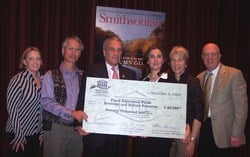
The Smithsonian/Tourism Cares for Tomorrow Sustainable Tourism Awards are five years old now. $20,000 is given to a finalist who has demonstrated innovation and success in conservation and $20,000 to an organization with similar attributes in preservation. The application form is difficult, and standards are high. Three finalists are chosen in each area and then posted on the website, where Smithsonian readers "vote" on the winners. Last year, we received literally hundreds of wonderful applications from around the globe, depicting projects which have built responsible, community-based tourism initiatives in new and exciting ways. The Smithsonian/Tourism Cares Awards are about recognition, and how to identify the best possible role models in the field. The cash awards help support those initiatives; I've never yet met a new project which has enough funding to reach its goals!
Is
there anything else you would like to say to our readers, perhaps
about details and deadlines of the award?
We are seeking the "best of the best" to hold up as models and reward for their work in sustainability. We want to support organizations which are tackling the challenges in new, ethical and responsible ways. Applications are available on the website www.sustainabletourismawards.com, and all materials are due by May 28, 2005. Can one awards program change the world? Of course not. But the Smithsonian and Tourism Cares organizations know that identifying best practices, holding up those models and investing in conservation and preservation is, quite simply, the right thing to do. I've had a wonderful career in the tourism industry, and I have a personal interest in ensuring that historic, natural and cultural sites be preserved for all the travelers of the future.
 Thank
you very much.
Thank
you very much.
NOMINATIONS DEADLINE: MAY
15, 2005 - EXTENDED TO MAY 28, 2005
SMITHSONIAN magazine and Tourism Cares for Tomorrow have joined forces for the fifth annual Sustainable Tourism Awards.
The collaboration between SMITHSONIAN magazine and Tourism Cares for Tomorrow highlights common goals of increasing awareness about environmental, cultural and wildlife conservation - both in the travel and tourism industries as well as for the 7.1 million monthly readers of SMITHSONIAN magazine.
2005 Sustainable Tourism Award for Preservation
The Sustainable Tourism Awards for Preservation is given annually to a
person, company or institution that supports preservation or
restoration of historic or culturally significant entities. The
recipient must demonstrate a clear connection between their endeavors
and tourism.
2005 Sustainable Tourism Award for Conservation
The Sustainable Tourism Awards for Conservation is given annually to a
person, company or institution in honor of work that enhances or
conserves the physical environment. The recipient must demonstrate a
clear connection between their endeavors and tourism.
Entries from around the world are invited to participate.
An esteemed panel of judges from the fields of publishing, tourism and science will determine the three finalists for each award from nomination submissions solicited around the world. SMITHSONIAN magazine readers will then select the winners via an online poll and Web site voting. Winners will be announced at the USTOA Annual Conference in December 2005.
For more information:
For more information about the Smithsonian/Tourism Cares
Sustainable Tourism Awards
 www.sustainabletourismawards.com
For more information about Tourism Cares for Tomorrow
www.tourismcaresfortomorrow.org
To contact Professor Mann:
Tel: +1 508 540 8169 (Case & Mann Consulting) or by email
Find the complete list of ECOCLUB Interviews here
Home|Ecolodges|News|Shop|Community|Chat|Library|Events|Advertise|Join|Recommend
Copyright © 1999-2005 ECOCLUB S.A. All Rights Reserved.
