|
|
||||
|
ISSN 1108-8931 |
INTERNATIONAL ECOTOURISM MONTHLY |
Issue 61 |
||
|
To celebrate our 5th anniversary, we held our first annual Ecolodge project competition, the "ECOCLUB Ecolodge Award 2004". ECOCLUB Members were asked to choose by email vote from project proposals submitted by Ecolodges around the world. The winners were Ranweli Holiday Village of Sri Lanka, (http://ecoclub.com/ranweli) who proposed the creation of an organic vegetable plot and green house in school premises close to the Lodge. The all-girl school has over one thousand students. Presenting the award at a live on-line event, ECOCLUB's Director noted that "this new Award is not a beauty contest, but aims to implement and verify the implementation of meaningful small-scale projects, by existing, successful, genuine Ecolodges, selected in a democratic fashion. ECOCLUB believes that genuine Ecotourism should be self-sustained, and supported from within, from its roots, rather than from governmental organisations and charities that arbitrarily splash out millions to the wrong hands, without even following up, and in so doing encourage corruption." RANWELI Director, Mr Chandra de Silva noted that "the ECOCLUB Ecolodge Award will further strengthen us in our endeavour to link the community with our enterprise. We hope to extend our Bio-Vegetable and pesticide free farming project through school children to the community, to areas of environmental conservation and education of the children. We thank the members of the Ecoclub for giving us this opportunity of taking forward the project." Ranweli Holiday Village proposed the creation of an organic vegetable plot and green house in school premises close to the Lodge. The proposal details were as follows: " Introduction: There is increasing public awareness of the dangers from chemical contamination from use of chemicals in agriculture largely due to people suffering from numerous diseases. Consequently, a programme of public/school based education to create awareness is necessary. Object: To establish an organic vegetable plot and a green house in school premises with the participation of staff and children of a school close to Ranweli ecolodge. Experience gained to initiate home gardens to achieve self sufficiency in organic / pesticide free vegetables. Strategy: Ranweli has established a link with the school to form a nature club. Discussion with the staff and school children demonstrated their enthusiasm to the project Steps: Conduct a workshop on organic farming, with resource persons to motivate and sensitise young persons to sustainable farming practices. 1. Our ecolodge horticulturist has visited the school and identified 8 x 8 metres plot for vegetable beds. The beds will be prepared by the children with the assistance of the Horticulturist by introducing top soil and compost from a pit to be established. 2. Seedlings will be provided from the nursery in the ecolodge pending the establishment of a nursery in the school. 3. The existing green house will be upgraded to grow salads. 4. We expect to harvest the first crop within three to four months. A mini ‘harvest festival’ will be held with participation of the staff, children and parents of the school which has around 2000 children. 5. The produce will be sold immediately after harvesting in a carnival atmosphere with music and dance by the children. 6. The sale proceeds will be used for expansion of the project to make it a continuing profit center of the school while propagating organic farming. " The 2004 Award is accompanied by the monetary sum of Euros 500, raised by ECOCLUB Members, and this amount is meant to cover the expenses of the project. Half of the funds will be awarded immediately, and the other half on completion of the project. The project implementation will be monitored and details, including photos, will be made available on-line, at http://ecoclub.com/award.html as the program progresses.
When arriving in Bolivia, as in any other country, tourists arrive with certain preconceptions. My preconceptions when I visited Bolivia for the first time where of a mountainous country dominate by the Aimara and Quechua populations. Images of the Altiplano and of Lake Titicaca sprung to mind as did thoughts of cold weather and high altitudes. And of course in that first visit to Bolivia that is exactly what I saw. But I also caught a glimpse of something a bit different, a brief sight of a side to Bolivia that didn't quite fit with the common preconceptions. I caught this brief insight as I rushed through the department of Santa Cruz on my way from Brazil to the Andes on the train from Quijarro (ok, so "rushed" isn't quite the right word for this train journey!). The City of Santa Cruz de la Sierra occupied me for one day before I managed to get to the mountains and return to the conventional tourist trail. In this first visit I was unaware that this part of Bolivia, the so called Bolivian Orient, had many interesting tourist areas worth visiting. I didn't know that Santa Cruz contained some of Bolivia's most important National Parks such as the Parque Nacional Noel Kempff Mercado and the Parque Nacional Amboró. Neither did I know that it was home to part of the Pantanal, and that this was better conserved than its more popular Brazilian counterpart, or that there was many intriguing towns to be explored along that same train line that traverses the area known as the Chiquitana. Luckily my second visit to Bolivia finds me situated more permanently in Santa Cruz and is giving me the chance to get to know this alternative Bolivia. It is also introducing me to an alternative type of tourism known as "Community-Based Ecotourism", a type of responsible tourism similar to the better known "Ecotourism" that is based in local communities and run and managed by those same communities. The Bolivian NGO PROBIOMA supports three such projects in Santa Cruz's Parque Nacional Amboró. The Parque Nacional Amboró is situated in the west of the department covering the eastern most spurs of the Andes. It is a hotspot for biodiversity, being at the convergence point of 3 ecological regions - the Amazon, the Andes, and the Northern Chaco - and ranging in altitude from 300m to 3300m above sea level. This diversity is represented both in flora and fauna. The park is home to the worlds highest number of different bird species registered in one area (over 650) and also boasts a huge variety of plant life and different types of vegetation cover. Set amongst the park are the three small communities of Villa Amboró, Isama, and Volcanes. Each of these communities have set up ecotourism refuges which are built of local materials and run in a sustainable way. The aim of these refuges is not only to provide an enjoyable and enlightening experience for tourists but also to promote environmental conservation and economic benefits for the communities. Although each refuge is individual, they have several things in common. Each is the starting point for numerous nature interpretation and adventure trails that take you through the surrounding landscape. These trails are always led by trained local guides who are experts in the nature of each area. Each site consists of one cabin for up to 6 people (2 sleeping rooms, eating area, and private bathroom) a campsite with the capacity for 15 people, a dining cabin, bathroom and shower, and hammocks.
So what can you expect from a stay in one of these community projects? Well, I recently had the opportunity to stay in both Volcanes and Villa Amboró for a few days, and this is what I found out. One of the great things about Volcanes is that it cannot be reached by any form of modern transport, meaning that once in the community you really feel like your in the wild. When I say great, I mean great if you like that kind of thing, of course! To reach the community therefore you must walk for around 8km along the Rio Colorado. This walk-in gives you your first sights of the spectacular mountains of this section of the park and also an opportunity to get to know your guides, ask questions about the community, about what you can do there, and about the surrounding nature. Arrival at the refuge should coincide with a well deserved and hearty lunch prepared by one of the local ladies. Among the trails that head off from Volcanes, a 12km circuit known as 'El Circuito' is the most rewarding. You must set off early to do 'el circuito' as it will take you most of the day. It takes you through gorges, up mountains, along rivers, and under a multitude of different forest types. At one point you will be amongst thick humid forest, at another under towering trees with their canopy high above you. The highlight of this trail for me is the 'viewpoint' which finds you on top of a mountain ridge with clear views of the mountains and rainforest all around you. The green carpet of forest spreads out before you, seeming to cover everything in its path, and you can hear parrots singing and insects chirping all around. On the trails the guides will help you spot and identify the different bird, mammal and plant species that you pass by. Although Amboró is richly diverse in animal species, spotting these creatures is not always easy due to the dense vegetation and the nocturnal habits of many of the creatures. However, a trained eye can pick up the tracks they leave behind, and in this way the guides often come across trails left by large animals such as anteaters and the elusive puma. The trails in Villa Amboró are generally shorter than those of Volcanes, and the rainforest, being lower and thus a little warmer, is denser and perhaps even more diverse. Unlike in Volcanes you have several options in reaching the community. If you have access to your own transport you can drive, if you like riding (or don't like walking!) you can ride in, or of course you can walk in too. However you choose to get there, you will arrive at a very different setting to that of Volcanes. The refuge is set in a clearing surrounded by dense jungle, which seems, in a very pleasant way, to cut you off from the world. Nearby to the camp are several deep pools perfect for cooling off, and a waterfall awaits you not far from the camp as well. However, the 2 main trails of this project head off either to several viewpoints that look out over the surrounding countryside as the mountains gradually start to rise up, or alternatively along the spectacular river Macuñucu. Monkeys are commonly spotted along these trails dancing through the canopy above you and the sharp eyed guides will point out other creatures that you might otherwise have missed.
But as I said at the start it is not only rewarding tourist experiences that these refuges provide. So what do the communities get out of it all? And how does it actually protect the environment of the area? In terms of the community, the benefits are varied. When a tourist arrives at the ecolodge they arrive knowing that every dollar they spend there will stay within that community. Given that the projects are run and managed by the communities, there are no outside agents or middlemen who must be paid. Obviously all the staff who work in the refuge (guides, cooks etc) receive their pay, but on top of this all the food used there is produced and bought locally, and the horses and donkeys that tourists make use of are also provided by other community members. In this way many community members benefit directly, but there are also indirect benefits for all the community including those who can't work within the actual project itself. This is done by means of a community fund which distributes the profits from the project into different areas of social development such as health, education, sport, and organisation. A committee of locals decides on how these funds should be used. The fund receives 50% of the profits for this, with the other 50% being reinvested into the ecotourism project for maintenance and improvements. Projects that have so far been carried out include the construction of a covered waiting area at one of the local health points, the construction of a room for the local teacher, and the provision of basic necessities for school (i.e. jotters, pencils etc.) to at least one member of every family in Villa Amboró. And the environment? Well, by providing an alternative form of income ecotourism relieves the temptation to carry out environmentally damaging practices such as extensive farming, deforestation, mining etc. It also turns the environment in its natural state into the economic asset for the communities, so as they become the defenders of these resources rather than the exploiters. For them, ecotourism now means that an area of pristine forest is more valuable as it is than if it were deforested and used for farming. The ecotourism projects give the forest long-term value, and the communities now want to conserve the forest so that their children too can benefit in this same way. And it is not just in the Parque Nacional Amboró where this type of community lead project operates. PROBIOMA also supports initiatives in two other parts of Bolivia, one in the small village of Chochis in the area known as the Chiquitana, and the other in the Bolivian Pantanal. Chochis is an interesting village with a painful history. In fact the village, which is situated at the foot of the spectacular Chochis Hill (Cerro de Chochis) has only existed for around 35 years. Close to the village at the foot of a tower of red rock is the Chochis Sanctuary, a catholic sanctuary built to commemorate the devastating floods and landslides of 1979 which ended the lives of many locals and destroyed much of the village. During the disaster the locals found refuge on the highland around the foot of this rock tower, and this is where the sanctuary can now be found. The building itself is impressive, not just for its location, but also for its architecture. Of particular interest is the woodwork, be it in the hand-carved pillars and doors, in the central 'Tree of Life', or in the panels depicting the disaster of 1979. The Chochis Hill is also worth the effort of climbing, as the views from the top are breathtaking. As well as this PROBIOMA is working in the Pantanal with the local fisherman and their communities with the aim of developing a series of ecolodge throughout this area which can be reached only by boat. These initiatives are both still in the initial stages of organisation and planning but once up and running will offer completely different ecotouristic experiences to those found in the Amboró, whilst at the same time aiding the conservation of two ecologically important areas, the Chiquitana Dry Forest (largest of its type in the world) and the Bolivian Pantanal (declared a RAMSAR site in 2001) To organise a trip to one of these projects it is best to contact the NGO PROBIOMA. PROBIOMA is in daily radio contact with the communities (this is the only way to communicate with them as there is no internet or even telephones in the communities) and can therefore help you to arrange your stay. They will provide you with information on getting there and what to expect once there. They will also advise on the costs of your stay and on what you should take with you, and will make sure that the guides are waiting to meet you when you arrive.
Listed in no particular order, after all this is Athens! Trek Mt. Parnitha National Park Watch a performance at "Dora Stratou" Traditional Dance
Theatre Have coffee in a traditional coffeeshop Swim in Lake Vouliagmeni Climb Mt Lycavitos, see the view and a performance. The Ancient Agora, a bird haven and hidden
Kerameikos. The old commercial centre, Athinas street
Some rare Museums Listen to authentic Greek blues - "Rembetika" music
Further to the South: Sounio and the Lavrion Ancient
Mines. Further to the west: Korinthos Canal ECOCLUB welcomes similar submissions, for details please see http://ecoclub.com/news/information.html |
||||
|
Home|Ecolodges|Experts|News|Shop|Community|Chat|Library|Events|Advertise|Join|Recommend |
||||
|
Copyright © 1999-2004 ECOCLUB S.A. All Rights Reserved. |
||||

 ECO
FOCUS
ECO
FOCUS

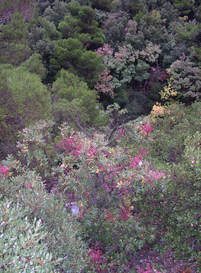 The lungs of Athens at
1,413 metres, Parnitha is a vast green area (30,000 hectares), with well-marked paths for
hiking to the various peaks, refuges. It contains impressive
biodiversity, including 29 mammal species, 120 bird species, and 818
plant species, although so close to Athens. For culture vultures there
are 2,600 year old ruins of the ancient fortifications which protected Athens
from invasions, as well as many 700 year old byzantine churches. There
are also some 20 caves and canyons, and a permanent platform for
paragliding with Athens on your feet.
The lungs of Athens at
1,413 metres, Parnitha is a vast green area (30,000 hectares), with well-marked paths for
hiking to the various peaks, refuges. It contains impressive
biodiversity, including 29 mammal species, 120 bird species, and 818
plant species, although so close to Athens. For culture vultures there
are 2,600 year old ruins of the ancient fortifications which protected Athens
from invasions, as well as many 700 year old byzantine churches. There
are also some 20 caves and canyons, and a permanent platform for
paragliding with Athens on your feet.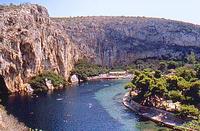 Now revamped, this is a medicinal spring
(sulphuric acid) and submerged cave with very deep,
clear waters. Right above the coast at Vouliagmeni, a southern suburb.
The lake is so deep that the Nazis during the occupation, allegedly
used
mini-submarines to find a deep opening to the sea, with the thought of
using it as a submarine station. But you can just swim, even
in winter time, as the water temperature is steady all year at 25
Celcius!.
Now revamped, this is a medicinal spring
(sulphuric acid) and submerged cave with very deep,
clear waters. Right above the coast at Vouliagmeni, a southern suburb.
The lake is so deep that the Nazis during the occupation, allegedly
used
mini-submarines to find a deep opening to the sea, with the thought of
using it as a submarine station. But you can just swim, even
in winter time, as the water temperature is steady all year at 25
Celcius!.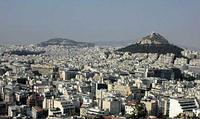 Mt.
Lycavittos is Athens' natural pyramid-shape scyscraper, at 277
metres. The origins of the hill's name are lost in prehistory, and it
is Acropolis's (156 metres) twin hill, right in the middle of the town. On a clear
evening you can see a majestic sunset and see the whole city, the
surrounding mountains, the sea, the nearby islands of Aegina, and even
the coast of the Peloponnese. Appropriately there is a cafe, and if
you are lucky there is a concert or a play at the nearby open air
theatre. Use the convenient paths to walk up the hill amidst a dense
urban forest of Aleppo pines!
Mt.
Lycavittos is Athens' natural pyramid-shape scyscraper, at 277
metres. The origins of the hill's name are lost in prehistory, and it
is Acropolis's (156 metres) twin hill, right in the middle of the town. On a clear
evening you can see a majestic sunset and see the whole city, the
surrounding mountains, the sea, the nearby islands of Aegina, and even
the coast of the Peloponnese. Appropriately there is a cafe, and if
you are lucky there is a concert or a play at the nearby open air
theatre. Use the convenient paths to walk up the hill amidst a dense
urban forest of Aleppo pines!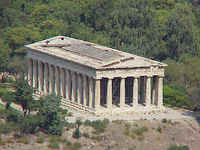 The Agora was were Athenians used to "agorazoun" (buy) or
"agorevoun" (make speeches), it was the heart of Athens for
some 700 years, frequented by traders, politicians, and the great
philosophers. Today it is a sprawling green site
interspersed with important relics, such as the best preserved
ancient temple in Greece, the Thisseion, dedicated to the god
Hefaistos, protector of the blacksmiths. The Agora area is an important haven for resident as well as
for migrant birds, as it has food and water, and is used it as a bird
pit stop in the heart of this city of 4 million. Nearby, but hidden, Kerameikos is one of the most beautiful and
least visited ancient sites, probably because tourists sense, perhaps
correctly, they have approached a rougher part of town. Kerameikos was
the ancient cemetery of Athens since the 12th century BC, and is
fittingly very peaceful, full of impressive monuments, and majestic grave
sculptures.
The Agora was were Athenians used to "agorazoun" (buy) or
"agorevoun" (make speeches), it was the heart of Athens for
some 700 years, frequented by traders, politicians, and the great
philosophers. Today it is a sprawling green site
interspersed with important relics, such as the best preserved
ancient temple in Greece, the Thisseion, dedicated to the god
Hefaistos, protector of the blacksmiths. The Agora area is an important haven for resident as well as
for migrant birds, as it has food and water, and is used it as a bird
pit stop in the heart of this city of 4 million. Nearby, but hidden, Kerameikos is one of the most beautiful and
least visited ancient sites, probably because tourists sense, perhaps
correctly, they have approached a rougher part of town. Kerameikos was
the ancient cemetery of Athens since the 12th century BC, and is
fittingly very peaceful, full of impressive monuments, and majestic grave
sculptures.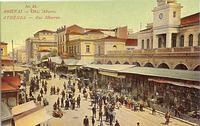 Omonia, Monastiraki, the Fish & Meat Market, Sunday bazaar at
Avysinia Square and a new and growing China / Kurdish / Indian Town,
the new multicultural Athens, can all be visited from colorful Athinas
street. Conveniently there are at 3 Metro stations in the area. Here you will find anything, including things you are not
supposed to.
Omonia, Monastiraki, the Fish & Meat Market, Sunday bazaar at
Avysinia Square and a new and growing China / Kurdish / Indian Town,
the new multicultural Athens, can all be visited from colorful Athinas
street. Conveniently there are at 3 Metro stations in the area. Here you will find anything, including things you are not
supposed to. Beyond
the well known museums, such as the
National Archeological, the Akropolis, the Agora, the Cycladic Art
Museum, some of
the lesser known are true gems, such as the Numismatic (Coin) Museum housed in the
former mansion of Schliemann, the German
merchant/ amateur archaeologist who discovered and excavated Troy. Or
the "Karagiozis"
Shadow Theatre Museum. Karagiozis is a vanishing popular art form,
with distant roots from India, this unique museum contains the
collection of 80 year old Eugenios Spatharis, the last of the great
Karagiozo-paihtes (Karagiozis players - his father was one too), at
Maroussi, a northern suburb. If you are lucky you can catch a
performance too.
Beyond
the well known museums, such as the
National Archeological, the Akropolis, the Agora, the Cycladic Art
Museum, some of
the lesser known are true gems, such as the Numismatic (Coin) Museum housed in the
former mansion of Schliemann, the German
merchant/ amateur archaeologist who discovered and excavated Troy. Or
the "Karagiozis"
Shadow Theatre Museum. Karagiozis is a vanishing popular art form,
with distant roots from India, this unique museum contains the
collection of 80 year old Eugenios Spatharis, the last of the great
Karagiozo-paihtes (Karagiozis players - his father was one too), at
Maroussi, a northern suburb. If you are lucky you can catch a
performance too. For hard core music lovers, Rembetika (early 20th century
underground "blues" music from Asia Minor) can be listened
to, and danced to, at the Rembetadika. Fittingly, the
one above the meat market ("Stoa ton Athanaton") is one of the best
! More rembetadika around
the Exarhia area. Rembetis meant "rebel" in the old slang,
and Exarhia preserves a rebellious spirit as an Anarchists den.
For hard core music lovers, Rembetika (early 20th century
underground "blues" music from Asia Minor) can be listened
to, and danced to, at the Rembetadika. Fittingly, the
one above the meat market ("Stoa ton Athanaton") is one of the best
! More rembetadika around
the Exarhia area. Rembetis meant "rebel" in the old slang,
and Exarhia preserves a rebellious spirit as an Anarchists den.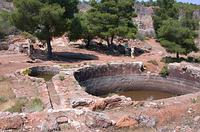 The Posseidon temple
(440 BCE) at Sounio, the southernmost tip of Attica, is much visited, with graffiti on
the column dating back to the middle ages, which shows that tourist
vandalism is a perennial human value. However the Lavrio silver
mines, across the temple and behind a hill, are little visited. These
mines were one of the sources of Athenian power in the classical era,
and one can still see the ancient proto-industrial installations. The
area is a National park, but few know about it or believe it when they
hear it, including the authorities. To cool off, combine with a swim
at a cove near Sounio, for some of the clearest waters in Attica.
The Posseidon temple
(440 BCE) at Sounio, the southernmost tip of Attica, is much visited, with graffiti on
the column dating back to the middle ages, which shows that tourist
vandalism is a perennial human value. However the Lavrio silver
mines, across the temple and behind a hill, are little visited. These
mines were one of the sources of Athenian power in the classical era,
and one can still see the ancient proto-industrial installations. The
area is a National park, but few know about it or believe it when they
hear it, including the authorities. To cool off, combine with a swim
at a cove near Sounio, for some of the clearest waters in Attica.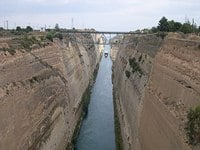 The thoughts of creating a canal joining the Saronikos and
Korinthiakos gulfs, so that ships would not have to
circumvent the Peloponnese or be carried overland on wheels, dates back to
600 BCE, and ambitious Roman
Emperors like Caligula and Nero - using a silver axe - had a go too.
They both gave up soon, and the feat was only
accomplished 1893, 24 years after Suez, and after 11 years of work
by over 2,500 workers. Today 12,000 ships pass every year from the 6
km-long narrow canal. One can visit the Isthmia museum, featuring rare drawings
depicting how ancient ships were put on huge carts with wheels, after
removing the cargo and transporting it on mules, and
carried overland to the other side on the diolkos (the paved
road on which ships were pulled), as well as the diolkos itself. If you are an adrenaline
freak you can also try bunjee jumping from the old
bridge crossing the canal, seen in the picture. Check that no ships are passing !
The thoughts of creating a canal joining the Saronikos and
Korinthiakos gulfs, so that ships would not have to
circumvent the Peloponnese or be carried overland on wheels, dates back to
600 BCE, and ambitious Roman
Emperors like Caligula and Nero - using a silver axe - had a go too.
They both gave up soon, and the feat was only
accomplished 1893, 24 years after Suez, and after 11 years of work
by over 2,500 workers. Today 12,000 ships pass every year from the 6
km-long narrow canal. One can visit the Isthmia museum, featuring rare drawings
depicting how ancient ships were put on huge carts with wheels, after
removing the cargo and transporting it on mules, and
carried overland to the other side on the diolkos (the paved
road on which ships were pulled), as well as the diolkos itself. If you are an adrenaline
freak you can also try bunjee jumping from the old
bridge crossing the canal, seen in the picture. Check that no ships are passing !