|
|
||||
|
ISSN 1108-8931 |
INTERNATIONAL ECOTOURISM MONTHLY |
Year 5-Issue 57, Feb. 2004 |
||
|
Cathy Parsons
|
||||
|
GREEN GLOBE 21 is the only worldwide environmental certification program designed for the travel and tourism industry. I believe there are a number of reasons why GREEN GLOBE has become one of the leading organisations in the area of certification for the tourism industry. Firstly, governments are demanding an improved environmental performance from all industry sectors. This is partly due and driven by the Kyoto Protocol, with the need to reduce greenhouse gas emissions, but also the desire for government to see triple-bottom-line reporting more widely adopted by industry. Indeed, in some countries this is now legislated. Secondly, I believe that communities are now expecting a higher standard of environmental performance, not only from tourism, but from a range of industries. The environment is now a high profile issue which is no longer just supported by green groups. It's a mainstream issue in many parts of the world. This of course has impacted on the tourism industry. Lastly, because the tourism industry can negatively impact on the environment, the industry has responded positively by embracing programs such as GREEN GLOBE. The program provides some simple tools to help tourism businesses measure environmental performance and demonstrate improved environmental outcomes.
The location of GREEN GLOBE in Australia has occurred as a result of a partnership between GREEN GLOBE Limited based in the UK and the Cooperative Research Centre (CRC) for Sustainable Tourism based in Australia. The CRC is now the largest research organisation in the world devoted to research on sustainable tourism and through its partnership with GREEN GLOBE, the Green Globe Asia Pacific office was established some three years ago to deliver the GREEN GLOBE program in this region. As part of the streamlining of the customer services function in 2003 it was agreed that Green Globe Asia Pacific should provide the services from its Australia office. I think this has proven to be successful given the strong support from the CRC particularly though its work in establishing Benchmarks for key environmental performance areas.
The process of certification under the GREEN GLOBE program ensures that there is a clear separation between the role of GREEN GLOBE, which receives a payment from a company to provide a service, and an independent assessor who separately contracts to deliver an assessment service. Globally we have two major companies, namely SGS and AJA, plus a number of independent assessors who must be formally qualified as auditors and have undertaken the GREEN GLOBE Training Course and passed the examination before they can conduct GREEN GLOBE assessments. We believe that the arrangements that exist which provide for independent assessments, ensure that there is no potential conflict of interest between GREEN GLOBE and the process of certification
There have been many studies done worldwide which show that consumers prefer to select tourism experiences or operations where there is a commitment to reduce their environmental impacts. However I do agree that there is less evidence of a strong behavioural link showing that tourists actually select environmentally certified businesses over ones that are not, if all else is equal. One of the issues of course for the consumer is that there is a plethora of ecolabels, particularly country specific schemes that are not well known outside of that country, and the cost of marketing green credentials globally makes it difficult for consumers to recognise different brands. GREEN GLOBE is of course trying to market its label and to ensure that its global brand is well recognised. This is being facilitated by our attendance at major events such as ITB, WYM and IMEX and by establishing alliances with major tourism bodies and companies. Our recent signing of Shell Gas LPG as a Corporate Partner is an example of this.
The prime motivation for most businesses is the bottom line because if they are not profitable, they will not stay operating. However, there has been a greater take up of the GREEN GLOBE program from resorts and hotel chains over the past few years by managers who genuinely regards the environment as an important factor in their business. All tourism businesses have the potential to reduce their environmental impact, for example by reducing their demand for energy and water. Sustainability of the resource upon which they depend is becoming a more prominent issue in the corporate world -not just in tourism.
I believe that voluntary certification for the private sector does take some pressure off government to regulate. This is, of course, assuming that the industry based schemes have credibility because they can then be recognised by government and can lead to reduce costs of government to regulate the industry. It is GREEN GLOBE's aim to get government recognition of the value of its program and to provide incentives then for operators to become Certified under GREEN GLOBE. For instance, in Western Australia the Department of Conservation and Land Management provides a longer permit for tourism operators who have GREEN GLOBE Certification. This permit extension means that, for the company, it will have some longer-term certainty about its operation on public land and also is able to demonstrate its environmental credentials to both government and to the public.
There is already pressure for us to expand the GREEN GLOBE program even though we currently provide Benchmarking Sector Indicators for 23 sectors plus communities and a new Design and Construct set of indicators. The requests have come for us to expand the system to deal with suppliers to the industry, for example catering firms, laundry services and so on. We would like to see tools to measure the environmental performance of all related sectors improve and we will certainly explore ways of doing this over the next 12 months or so.
Yes, of course we would uncertify a large hotel chain or airline if it was shown that they no longer met our GREEN GLOBE Standard. The credibility of our scheme is absolutely paramount. If complaints are received we would ask a business to show cause and, depending on the severity of the complaint, we would require either an assessment to be done immediately or at the next assessment we would ask that the assessor make specific investigation of the complaints. People who do have concerns about any aspect of GREEN GLOBE Certified businesses should contact us at our Customer Services email address customer.services@greenglobe21.com. The experience to date is that hotels will drop out of the scheme if they know that they cannot devote the resources to ensure that they maintain their standards. It is also relevant that those who have failed some of their benchmarking indicators have had to work to improve these so that they can continue to remain in the GREEN GLOBE program.
The first level of the GREEN GLOBE program is the Awareness level at which people join to become Affiliates. I don't believe there should be any confusion about what is used for this level. The stamp that companies are allowed to display clearly says GREEN GLOBE Affiliate. We will however be reviewing the requirement for becoming an Affiliate, as we would like to see companies at that level provide some tangible evidence of their environmental commitment. Currently this is not necessary. There is some disincentive to remain as an Affiliate beyond the first year, as the fee rises significantly, and our experience to date has shown that many companies are not prepared to pay this higher fee in order just to display a GREEN GLOBE Affiliate stamp.
We do not see competition as being a bad thing. In fact, we believe that there is room for various schemes that offer alternative approaches to the tourism industry. We do strongly support the concept of accrediting environmental schemes and we have been part of a steering committee run by the Sustainable Tourism Stewardship Council which is exploring a means of accrediting environmental certification programs around the world. We have also sort to collaborate with VISIT, which is an organisation that has been established to recognise ecolabels in Europe. I think that what we can expect to see by 2020 is some rationalisation of labels around the world as there is likely to be greater regulation by government. Government, I think, will seek independent certification from bodies so that a tourism business that operates on public land must have some environmental certification. This is likely to be the most cost effective way for governments to move in future, whilst maintaining a high level of environmental performance by the tourism industry. GREEN GLOBE is a program that continually aims to improve. We have an International Advisory Council comprising members from diverse backgrounds including tourism industry, assessor organisations, environmental groups and through this forum we seek to ensure that the GREEN GLOBE Standard continues to maintain its currency and its credibility. For those people who may have looked at GREEN GLOBE in the past and made the decision, for whatever reason, not to become part of the program, I encourage them to regularly review the GREEN GLOBE website so that they can be aware of the changes that the program has undertaken in order to maintain a key position in environmental certification for the travel and tourism industry.
GREEN GLOBE 21 is a worldwide benchmarking and certification program which facilitates sustainable travel and tourism for consumers, companies and communities. It is based on Agenda 21 and principles for Sustainable Development endorsed by 182 governments at the United Nations Rio de Janeiro Earth Summit in 1992. There are 4 GREEN GLOBE 21 Standards: the Company Standard; the International Ecotourism Standard; the Community Standard and a new Design and Construct Standard.
Find the complete list of ECOCLUB Interviews here
|
||||
|
Home|Ecolodges|News|Shop|Community|Chat|Library|Events|Advertise|Join|Recommend |
||||
|
Copyright © 1999-2004 ECOCLUB S.A. All Rights Reserved. |
||||

 THE
ECOCLUB INTERVIEW
THE
ECOCLUB INTERVIEW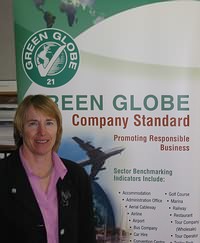 Cathy
Parsons is currently the Chief Executive Officer of Green Globe Asia
Pacific Pty Ltd and Global Manager of GREEN GLOBE 21. She is
responsible for all aspects relating the development and delivery of
the GREEN GLOBE 21 program. During 2002, Cathy was the Executive
Director of Green Globe Asia Pacific, responsible for building and
maintaining relationships with government and peak tourism industry
bodies as well as dealing with all operational matters including
marketing and customer services. Prior to taking up the position with
Green Globe Asia Pacific, she worked as a Senior Executive in the
Australian Government for over 15 years. During this time she was
responsible for dealing with a range of tourism and environmental
issues.
Cathy
Parsons is currently the Chief Executive Officer of Green Globe Asia
Pacific Pty Ltd and Global Manager of GREEN GLOBE 21. She is
responsible for all aspects relating the development and delivery of
the GREEN GLOBE 21 program. During 2002, Cathy was the Executive
Director of Green Globe Asia Pacific, responsible for building and
maintaining relationships with government and peak tourism industry
bodies as well as dealing with all operational matters including
marketing and customer services. Prior to taking up the position with
Green Globe Asia Pacific, she worked as a Senior Executive in the
Australian Government for over 15 years. During this time she was
responsible for dealing with a range of tourism and environmental
issues.
