|
|
||||
|
123 Flash Menu Placeholder.
|
||||
|
" Do we support mega-resorts with unpredictable costs for nature and the tax payer, which carry short-term benefits or do we want to develop the idea of ecotourism, with long-term guarantees for the population and the tourists coming to our country? "
About the European Green Party (EGP): The EGP is a transnational political party whose members are Green parties from European countries. Green political movements started to emerge in Europe in the mid-seventies. A coordination body of European Green Parties was founded in 1984 and in 1993 became the European Federation of Green Parties. In 2004 the federation was transformed into the European Green Party with 32 green parties as founding members. For the 2009 parliamentary elections the EGP's motto is "A green new deal for Europe" (http://europeangreens.eu/). Greens-EFA are currently the 5th largest group in the European parliament with 43 MEPs (5.48% of seats).
Michael Cramer: The idea of establishing the "Iron Curtain Trail" is based on a very successful model of cycling tourism from Berlin and Germany. When tourists come to Berlin they often ask: "Where was the wall?" and since the city's surface changed so rapidly in the last years it has become difficult to find historical traces. Today, tourists in Berlin can cycle 160 km around West Berlin, experiencing urban changes and remaining monuments along the line. A similar trail has been drawn along the 1.400 km long former German-German border line. The model of bicycle tourism has proved to work extraordinary well, this is why it has been transferred to the European level. Travel guides for Berlin and Germany exist already in English and German, a similar guide for the "Iron Curtain Trail" will be published in both languages in summer this year.
Michael Cramer: Tourism in general is a horizontal issue, which involves different sectors and which is of great economic relevance in Europe. When we talk about tourism we have to discuss questions of transport, cultural heritage, nature protection, water and waste management, energy and social conditions. Ecotourism by definition should include a balanced and sustainable approach to all these factors. There is a huge potential in all these sectors. Means of transport should be more sustainable. This would not only bring an economic and ecologic benefit for customers but for the whole local population. If a shared transport system of public busses, trains or taxi transportation (as well as ferry boats in Greece) was to be established all users would profit from it. Especially countries like Greece, which are rich in cultural heritage, historical places and monuments, should protect sensitive areas. Tourists should be guided through, in order to avoid any damage. The use of renewable energy is also a huge potential for Greece: scientific studies say that up to 60 % of the total energy consumption (without transport) could be covered by renewable energy including wind, geothermal and sun sources. This is an important fact, since it shows that Greece - and mainly its islands - could become to a great extend completely independent from fossil energy imports. In my opinion, any destination in Europe could become an eco-destination as long as they fulfil the sustainability criteria I mentioned. Of course, to stay locally close to your home place avoids transport costs and therefore diminishes a big part of the costs that occur when you travel. But in many European countries most trips are within the country itself and only a small percentage of people travel to long-distance destinations.
Michael Cramer: A very good question! These resorts unfortunately show a different approach to tourism than I do. Most of them are not only an economic and social disaster. Several questions remain unclear: What are their solutions for water and waste management? How are natural reserves and areas protected of non-transparent construction measures? Do they include the local population on a long-term, e.g. employment? If we talk about EU-funding, it has to be clear that EU-money can only be spent on co-financed projects. This means that at least half of the spending has to be covered by local and/or state budget. The question is: Do we support mega-resorts with unpredictable costs for nature and the tax payer, which carry short-term benefits or do we want to develop the idea of eco-tourism, with long-term guarantees for the population and the tourists coming to our country?
Michael Cramer: Most people are not only travelling by plane to reach their touristic destination but mainly by car! The problem of price differences between the means of transport is due to the unequal level of internalisation of external costs. External costs include air and noise pollution, but also accidents, traffic jams and health problems caused by traffic movements. There is a Europe-wide binding toll for trains for example but not for cars or trucks. That is why train companies - and their customers in the end - have to bare these expenses but airlines and truck or bus companies do not. We - as Greens - reached a first step in the European Parliament when we introduced the emission trading system (ETS) also in the aviation sector from 2012 onwards but we failed to install a kerosene tax. Therefore the European tax payers will have to spend every year € 14 billion for passengers in the air - a big sum of money which is missing when modernising of the railway system. We also agreed on a proposal to include certain external costs for trucks. But we still need to improve quite a lot in this field. If you consider the true cost of different means of transport, then you realize how subsidies and unequal charges have influenced negatively the price transport customers pay today. In fact, there are already high-speed lines that replace short distance flights. This general trend goes along with the permanent improvement of the railway network. In the long run, trains will therefore become more attractive and cheaper.
Michael Cramer: I think this critic is not fair and I do not really share it. First, if we do not set high ecological standards, we undermine our own efforts in burden sharing in climate change. And secondly, what you call green taxes is simply the expression of real damage that might be caused to every one of us let it be health, social or ecological issues. What is truly unfair is the fact that a tax payer majority subsidises indirectly a small number of airline passengers with the effect that tickets prices remain artificially low. Concerning people with lower income: they are disadvantaged since they do not have the financial means to pay the use of a car. In some cities public transport tickets are too expensive as well so they - wanted or not - are excluded from social life. All these are facts we want to change with the introduction of fair pricing!
Michael Cramer: This is a very optimistic outlook, but I think, Greens will indeed win more seats in the upcoming European elections. I am optimistic that there will also be a Greek Green joining us next term! Of course, we continue with our efforts in promoting a sustainable tourism policy under the conditions mentioned earlier. In fact, once the Lisbon Treaty will be ratified by all EU member states, we will even have a legal basis to operate on. Article § 195 under Title XXII gives the European Union more competences in the area of tourism, which so far has not been the case. According to this article the European Parliament will then have the power to exercise its full co-decision right concerning the budget. It gives us the possibility to influence in a more efficient way decisions on sustainable tourism and to provide a good basis for further action.
Michael Cramer: Yes, there can be! Tourism is one of the sectors that - until now - has been less affected by the economic crisis. The cut in airline flights is mostly due to less business trips and not due to less tourists travelling. Europe remains a huge market for tourism, where mainly small and middle-sized enterprises benefit from. The idea of the Green New Deal is to combine ecological and economic stimulus. The tourism sector is an ideal field to create jobs e.g. in eco-tourism. People are constantly paying attention to the way they travel. We should certainly build on this and take the current crisis as an opportunity to enhance behavioural change, even more since climate change increasingly effects our daily life.
Background Notes & Commentary:
The "Berlin Wall Trail" is a 160 km trail along the former border around West Berlin. As a Member of the Berlin Chamber of Deputies, Michael Cramer initiated this trail in order to "allow people to experience the history, culture and politics in the truest sense of the word, and as a vivid and exciting way to combine soft mobility with city tourism". As he puts it: "We can learn a lot from this successful concept for larger-scale projects. The “Berlin Wall Trail” concept was successfully transferred to the national level with the creation of the 1,400 km “German German Border Trail” along the former Inner German border. The "Iron Curtain Trail" is still in development. It's aim according to Michael Cramer is to also transfer the idea of ‘experiencing history’ to a European level as well. "This 6,800 km trail guides cyclists with an interest in history from the Barents Sea on the Norwegian-Russian border to the Black Sea along what used to be the Iron Curtain, which is now no longer a dividing line but a symbol of a shared, pan-European experience in a reunified Europe. This was also a reason why, in the autumn of 2005, my proposal to include the project in the European Parliament’s report on ‘new prospects and new challenges for sustainable European tourism’ was adopted by a large majority. Twenty countries, 14 thereof EU Member States, are involved. The “Iron Curtain Trail” is part of Europe’s collective memories which can help promote the much talked-about European identity. In addition, particularly due to its isolation, the former border zone has paradoxically now become a unique habitat for plants and wildlife. Since 2002 this ‘Green Belt’ has been under the patronage of Mikhail Gorbachev, the former President of the Soviet Union and now President of ‘Green Cross International’ (GCI).
For those inspired to take an independent cycle trip along a formerly heavily-guarded border, a series of three books covering the entire trail is also being produced by the Austrian publisher, Esterbauer Verlag. These books from the “bikeline” series contain a detailed description of the route and points of interest and provide accurate maps and tips on where to shop, eat and stay. These peace-building, progressive & ecological initiatives are
positive, but reading about the endless misery of Africans and Latin Americans
trying to cross the borders into fortress Europe & fortress United States, and
new fences, visible & virtual being raised one realises there is still a lot of
work to be done so that we can one day see a world with bicycles, without
borders for all, with two-way traffic.
Disclaimer: Any views expressed in this magazine belong to their respective authors and are not necessarily those of ECOCLUB S.A. Although we try to check all facts, we accept no liability for inaccuracies - which means you should not take any travel or other decisions based only on what you read here... Use of this magazine is covered by the Terms & Conditions of the ECOCLUB.com Website and by your uncommon sense and good humour. |
||||


 ECOCLUB
Interview with Michael Cramer
ECOCLUB
Interview with Michael Cramer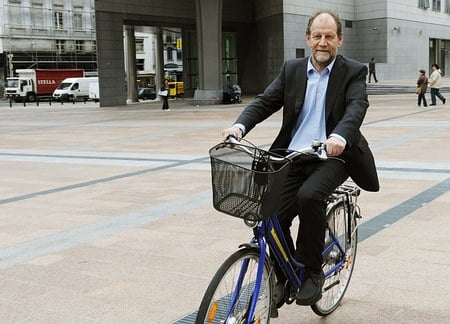
 Michael
Cramer: This year is the 20th anniversary of the fall of the Berlin
Wall. For almost half a century the so-called "Iron Curtain" forcefully
divided Europe into East and West. In remembrance of Europe's reunification
I developed the idea of a cycling and hiking trail all along the former
separation line, the so-called "Iron Curtain Trail" combining sustainable
tourism with historical discovery. The project has been officially
recognised by the European Parliament and will also get financial support
for its realisation. The Greens and many cyclists will be touring until the
day of the European election on June 7th through those 14 EU member states
that were once separated by the Iron Curtain. The first stage took place in
Bulgaria and Greece close to the Turkish border. A group of nearly one
hundred cyclists from Bulgaria, Greece and Turkey joined the cycling trip
and proved in an impressive way that cycling is not only fun but can also
connect people in Europe and illustrate history in an active way. At the
same time it is a very good example of promoting sustainable tourism in the
new EU member states but also in South-East Europe.
Michael
Cramer: This year is the 20th anniversary of the fall of the Berlin
Wall. For almost half a century the so-called "Iron Curtain" forcefully
divided Europe into East and West. In remembrance of Europe's reunification
I developed the idea of a cycling and hiking trail all along the former
separation line, the so-called "Iron Curtain Trail" combining sustainable
tourism with historical discovery. The project has been officially
recognised by the European Parliament and will also get financial support
for its realisation. The Greens and many cyclists will be touring until the
day of the European election on June 7th through those 14 EU member states
that were once separated by the Iron Curtain. The first stage took place in
Bulgaria and Greece close to the Turkish border. A group of nearly one
hundred cyclists from Bulgaria, Greece and Turkey joined the cycling trip
and proved in an impressive way that cycling is not only fun but can also
connect people in Europe and illustrate history in an active way. At the
same time it is a very good example of promoting sustainable tourism in the
new EU member states but also in South-East Europe.  The
'Iron Curtain', still a controversial term, with possible origins
in the iron safety curtains traditionally used in theatres, was a phrase
Goebbels used in the last days of WW2 to warn the West against a Soviet victory.
It became mainstream in the West when it was used by Winston Churchill in his
"Sinews of Peace" address in 1946. Between 1945 and
1989 it signified a long border, stretching over 7,000 km through Europe from
the Barents Sea to the Black Sea dividing Germany, Europe and the world into
East and West, communist & capitalist, greatly reducing trade, travel & tourism
& information flows between the two sides. Twenty years after, except from a few
deliberately preserved parts serving as museums, visible remnants are as few as
those complaining about its absence.
The
'Iron Curtain', still a controversial term, with possible origins
in the iron safety curtains traditionally used in theatres, was a phrase
Goebbels used in the last days of WW2 to warn the West against a Soviet victory.
It became mainstream in the West when it was used by Winston Churchill in his
"Sinews of Peace" address in 1946. Between 1945 and
1989 it signified a long border, stretching over 7,000 km through Europe from
the Barents Sea to the Black Sea dividing Germany, Europe and the world into
East and West, communist & capitalist, greatly reducing trade, travel & tourism
& information flows between the two sides. Twenty years after, except from a few
deliberately preserved parts serving as museums, visible remnants are as few as
those complaining about its absence. On
April 14 April 2009, the Iron curtain cycling trail took in Bulgaria, Greece and
Turkey. A group of nearly one hundred cyclists from Bulgaria, Greece and Turkey
joined the tour and demonstrated that cycling is not only fun but can also
connect people in Europe and provide insight to history in an active way. The 70
km long tour started in Svilengrad, Bulgaria and ended in Orestiada, Greece. In
the town of Kastanies bikers from Turkey joined the Bulgarian-Greek cycling
group. Schoolchildren and older persons joined the group as well as professional
cycling athletes. Mayors and prefects of the region spoke in support of
sustainable transport in cities and the need to promote bicycle tourism in the
region. The next bicycle tour with Michael Cramer will be on 26th of April in
the tri-border region between Hungary, Austria and Slovenia. More information
can be found on
On
April 14 April 2009, the Iron curtain cycling trail took in Bulgaria, Greece and
Turkey. A group of nearly one hundred cyclists from Bulgaria, Greece and Turkey
joined the tour and demonstrated that cycling is not only fun but can also
connect people in Europe and provide insight to history in an active way. The 70
km long tour started in Svilengrad, Bulgaria and ended in Orestiada, Greece. In
the town of Kastanies bikers from Turkey joined the Bulgarian-Greek cycling
group. Schoolchildren and older persons joined the group as well as professional
cycling athletes. Mayors and prefects of the region spoke in support of
sustainable transport in cities and the need to promote bicycle tourism in the
region. The next bicycle tour with Michael Cramer will be on 26th of April in
the tri-border region between Hungary, Austria and Slovenia. More information
can be found on 

