|
ECOCLUB Interviews are a true who is who of the ecotourism movement |
||||
123 Flash Menu Placeholder.
|
||||
|
|
||||
|
ISSN 1108-8931 |
INTERNATIONAL ECOTOURISM MAGAZINE™ |
Year 8 - Issue 96 - Mar 08 |
||
|
This issue sponsored by:
Siam
Safari Nature Tours (TH),
Canyon Travel
(MX),
La Selva
Jungle Lodge (EC),
|
||||
HABIS SAMAWI: "Decision makers are not very aware about ecotourism issues, most think only about attracting more economic development"
|
||||


 Dr
Samawi obtained his B.A. in Geography from Beirut Arab University an MA in
Geography of Tourism from Alexandria University, Egypt and a Ph.D. in
Geography of Tourism from the University of Cincinnati, Ohio, U.S.A. He
has held various academic and professional posts, including Researcher for
The Ministry of Tourism in Jordan, Director of Tourist Guides Program in
Jordan University, supervising over 35 Groups and Associate Professor in
the Dept. of Information, Tourism & Arts of the University of Bahrain. A
keen supporter of Ecotourism, Dr Samawi presented a paper on “Perceptions
and preferences of Tourists toward selected Ecotourism Destinations in
Bahrain” at the Global Ecotourism conference 2007, in Oslo, Norway, while
he has also produced various ecotourism papers including “Ecotourism in
Petra, Jordan”, “Ecotourism in the Arab World” and “Marine Ecotourism in
Bahrain”. He lives in Amman, Jordan.
Dr
Samawi obtained his B.A. in Geography from Beirut Arab University an MA in
Geography of Tourism from Alexandria University, Egypt and a Ph.D. in
Geography of Tourism from the University of Cincinnati, Ohio, U.S.A. He
has held various academic and professional posts, including Researcher for
The Ministry of Tourism in Jordan, Director of Tourist Guides Program in
Jordan University, supervising over 35 Groups and Associate Professor in
the Dept. of Information, Tourism & Arts of the University of Bahrain. A
keen supporter of Ecotourism, Dr Samawi presented a paper on “Perceptions
and preferences of Tourists toward selected Ecotourism Destinations in
Bahrain” at the Global Ecotourism conference 2007, in Oslo, Norway, while
he has also produced various ecotourism papers including “Ecotourism in
Petra, Jordan”, “Ecotourism in the Arab World” and “Marine Ecotourism in
Bahrain”. He lives in Amman, Jordan.
 |
|
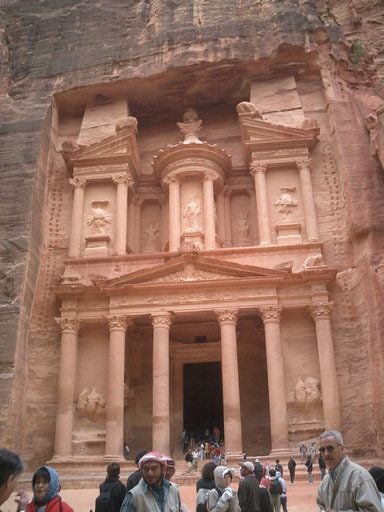
The World Heritage Site of Petra |
As you know, tourism has two aspects, the positive one where Jordan has gained more hard currency, income and more employment opportunities for their people, around 32,000 new jobs in Jordan according to 2006 statistics. For the negative, I can see pollution and other social problems, the local people always complaining and some times rejecting the western tourists’ behaviour. Most tourist sites in Jordan attract cultural tourists, and these are mainly elderly people and they cause no problem to the local communities. I think in Aqaba we might have some resistance between the locals and tourists in the beginning. Locals are always complaining because in some areas they are not benefiting from tourism. For example in Petra, Rum, Dhana local people are so happy to coexist with tourists, but for the rest sites such as Jerash, Madaba, Ajlun, Umm Quies and Aqaba the attitude of the locals is negative toward tourists.
 ECOCLUB.com:
How high on the agenda, is environmental protection and
water conservation in particular when it comes to new tourism project
developments in Jordan? Is there an adequate ecotourism legal framework in
place?
ECOCLUB.com:
How high on the agenda, is environmental protection and
water conservation in particular when it comes to new tourism project
developments in Jordan? Is there an adequate ecotourism legal framework in
place?
Yes, Jordan is very aware about environmental issues, so before making any tourism development in any area they usually consider the environment. One of the most important issues that is facing Jordan is the shortage of water, and you know tourists are consuming water more than the locals. In Jordan, you can see a lot of natural reserves such as Dhana , Shumeri ,Dubin and many others. So I see Jordan as the most environmentally-conscious Arab country. But for sure we are still behind western Europe. There is an adequate legal framework for ecotourism but the problem is its application: for example, the RSCN has set laws and policies to preserve and conserve nature and tourists sites. There is a big project going to take place in one of the sensitive areas in Dubin-Jordan very close to Dubin reserve. The only people who expressed concern about the project were RSCN. The project is currently under way, however many changes were made so as to protect the environment.
ECOCLUB.com:
Is the western beach culture, the sea sun & sand tourism really compatible
with prevailing traditions and social norms in Jordan, or is Aqaba and Wadi Rum
accepted as a sort of special enclave where beach culture - and even overnight
rave parties are tolerated so that mainstream young westerners are attracted to
visit Jordan? Is any alternative strategy focusing on ecologically & culturally
sensitive travellers also followed?
Without any doubt, there is a difference between the needs, the beliefs and the attitudes between Arabs and Western Europeans, at the moment I do not think that Jordan is ready to host young tourists, and especially in Aqaba we will see some reluctance from the locals. In case of the cultural tourists I think it is not causing any troubles among the local communities. Frankly speaking the economic development council in Aqaba are the only people who can decide about tourism projects in the area, they consider some issues, but I am sure if there is they are presented with an ecotourism study, they will stop the tourist projects especially in Aqaba, because they are against the environment. Wadi Rum right now is still doing well.
ECOCLUB.com:
Has Tourism, as in other countries, resulted in or at least
promoted an
emancipation / empowerment of women in Jordan, and has this created any
tensions?
Jordan is different than many Arab countries; the women in Jordan have the right to vote and to reach a high position, so now you will find more than three women holding the post of government minister. At the same time women have the right to go to universities, where you can find real competition between men and women. But again we can not compare ourselves with the western communities. The role of women is still small even when you go to high education in tourism, you will find women demand in tourism education is less than for men, because of traditions and customs. I think it is a matter of time. Twenty years ago men used not to be in favour of working in hotels, but now all things have changed: 95% of workers in tourism are Jordanians, out of which 15% are women.
ECOCLUB.com:
Is Tourism gaining in popularity in Jordanian universities in terms of
number of students, Tourism departments and courses taught, and what about
Ecotourism?
Yes there is a big demand in Jordan universities for tourism programmes so more than 8 universities out of 18 are offering one major in tourism, and in October 2007 a big conference was hosted by Jordan Applied University and The college of Hospitality Tourism Education about the future of tourism education in Jordan. For Ecotourism education yes there is a good movement. There are more courses and workshops to be held in the area in coordination with RSCN and the Ministry of Environment and UNEP. By the way UNEP have a base in Bahrain and I worked there as a consultant since 2000. We have produced many reports and held many workshops in Lebanon, Egypt, Oman and Oslo–Norway. I produced with UNEP two reports one about sustainable tourism in hotels, and the other about sustainable tourism in the Arab World. At the same time the Tourism sector has now become very aware about ecotourism issues, so with the help of TIES a workshop was held in Amman in January 2008.
ECOCLUB.com:
You have also greatly researched Tourism in Bahrain. Once
upon a time most Gulf countries rejected international tourism. What prompted
this sea change? How sustainable is the Bahrain tourism model, in an
environmental, social and economical sense, and does it differ at all from the
Dubai model?
My main experience is based on Bahrain where I stayed for 5 years. Tourism became an important way to attract more Arab and foreign investment, but the problem here is not with the people but with the decision-makers, most people are aware about the negative impacts that big tourism projects may cause to the sensitive shores. The real problem as I mentioned lies with the decision makers: three or four big tourism projects have recently been established and they are impacting negatively on the environment. In Oman for example they held last year a big international conference in Ecotourism. I hope neither Bahrain nor Oman are going to copy the Dubai model. The decision makers are not very aware about ecotourism issues, most think only about attracting more economic development and big project regardless of the social and environmental impacts.
ECOCLUB.com:
After the rather-hyped "New Seven Wonders of the World"
competition, even the most ignorant will have now heard of the cultural &
natural wonder that is Petra, a UNESCO World Heritage Site. But how is Petra
coping with the growing affection? Are there plans to cap the number of
visitors, raise prices or are other visitor management tools being considered?
Jordan was proud to have Petra listed among the new 7 wonders. I think this will not change much, because we all know the importance of Petra among the rest of the cultural sites in the world, it is really magnificent not only for Jordan but for the whole world. I think it might attract more tourists, but again we have to keep an eye on the number of tourist arrivals in order to preserve the location for the new generations. I think we are going to limit the number of tourists in Petra. There are many ways to eliminate excessive tourist numbers in sensitive sites such as by increasing entrance fees, through a management plan to limit, or by educating locals and tourists about the sensitivity of Petra.
ECOCLUB.com:
Finally, what sites would you recommend to Ecotourism enthusiasts in
Jordan?
I can suggest so many sites, such as Petra, Jerash, Madaba, Dhana reserves, Wadi Rum. I recommend Petra because it is very rich in their nature and culture, it is one of the best preserved ancient sites in the world, this was the reason it was nominated as one of the new 7 Wonders of the World, and also there is a good management plan to conserve the whole site. In Wadi Rum there is the Rum Reserve where RSCN is monitoring the development of any tourist projects - they do not let any hotel to be established in the area. In addition Dhana reserve and the Baptism site are really well preserved sites and locals are being trained to work in both locations. Thank you for the great opportunity to express my ideas to you and to the ECOCLUB.
ECOCLUB.com:
Thank you very much!

The Martian Landscape of Wadi Rum
 Find the
complete list of ECOCLUB Interviews here
Find the
complete list of ECOCLUB Interviews here
Disclaimer: Any views expressed in this magazine belong to their respective authors and are not necessarily those of ECOCLUB S.A. Although we try to check all facts, we accept no liability for inaccuracies - which means you should not take any travel or other decisions based only on what you read here... Use of this magazine is covered by the Terms & Conditions of the ECOCLUB.com Website and by your uncommon sense and good humour.
