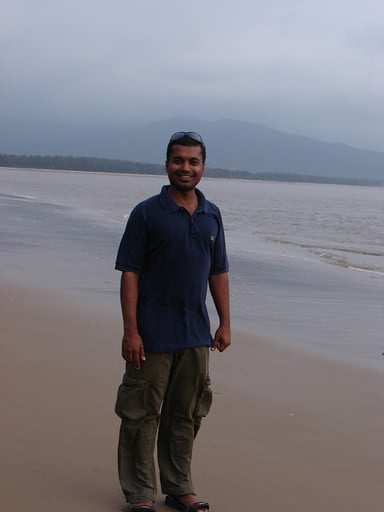
 Gopinath
Parayil (Gopi) is the founder of award-winning The Blue Yonder,
a 'responsible travel' company based in Bangalore, India. Before setting
up The Blue Yonder, Gopinath worked with software companies, NGOs and
consulted in Disaster Management. After leaving his job as a professional
fundraiser for a Children's NGO in the UK, he pursued his passion for a
dying river in Kerala leading to the formation of Nila Foundation. Seeing
the potential of positive changes that Tourism can bring in the lives of
people along the banks of River Nila, Gopi kick-started the movement of
Responsible Tourism in India.
Gopinath
Parayil (Gopi) is the founder of award-winning The Blue Yonder,
a 'responsible travel' company based in Bangalore, India. Before setting
up The Blue Yonder, Gopinath worked with software companies, NGOs and
consulted in Disaster Management. After leaving his job as a professional
fundraiser for a Children's NGO in the UK, he pursued his passion for a
dying river in Kerala leading to the formation of Nila Foundation. Seeing
the potential of positive changes that Tourism can bring in the lives of
people along the banks of River Nila, Gopi kick-started the movement of
Responsible Tourism in India.
The recipient
of First Choice Responsible Tourism Award for Poverty reduction at the World
Travel Market 2006 in London, The Blue Yonder (Web:
www.theblueyonder.com) was set up in
2003 to support the work of Nila Foundation. The Nila Foundation had been
set up to revive and regenerate a dying river, Bharatapuzha (River Nila) in
Kerala. Initially started as a project in North Kerala, surrounding River Nila,
The Blue Yonder (TBY) organises tours that give in-depth understanding of the
river culture and which provide alternative and supplementary sources of income
for various communities. The TBY model is now being implemented in six other
Indian states: Rajasthan, Karnataka, Sikkim, Orissa, Himachal Pradesh and
Uttaranchal.
(The Interview follows:)
 ECOCLUB.com:
What was it that first attracted you to Ecotourism and Responsible
Tourism?
ECOCLUB.com:
What was it that first attracted you to Ecotourism and Responsible
Tourism?
Gopinath
Parayil: When we set up Nila Foundation to do research on river
conservation, we were definite that we would not depend on funding agencies
to sustain the functions of the organisation. We didn't want our dreams to be
dictated by some insensitive funding agency. So it was while looking for
a sustainable funding support for the Nila Foundation activities, that we
started exploring the options of using tourism as a tool for generating income
for the foundation.
This was also an
opportunity for us to tell the world about a dying river that was once the life
line of Kerala with its contribution to a unique river valley civilization.
Since the central theme of our holidays were initially surrounding the sadly
depleted river, it only made sense for us to introduce a travel culture that
was sensitive to the local surroundings; including our people and the
environment in which they lived.
ECOCLUB.com:
Your company was set up with the concept of Corporate Social
Responsibility from scratch. How would you define CSR in theory, and what does
it mean for your company in practice?
Gopinath
Parayil: CSR is one of the many abused terms similar to the green washing
that has happened in the travel industry in the name of eco tourism. For us,
CSR is not about PR exercise. Nor is it about just sharing a bit of profit that
you make out of your business to make one look 'balanced' or 'just'.
As I mentioned
earlier, the work we are doing came out of our 'responsibility' to our
surroundings. Tourism was only one of the several elements that came into the
broader frame work of our CSR. It was out of our 'responsibility' that we
decided to set up Nila Foundation to do our bit to preserve and revive a dying
river and its cultural ethos.
While the
initial objective of The Blue Yonder was to be of a financial engine to support
activities of Nila Foundation, later it evolved into an organisation that
created alternative and supplementary jobs in villages that were never
part of conventional tourism circuits in Kerala.
Since
accommodation providers and property owners were an integral part of our
programs, we set up an associate network called ‘The Blue Yonder Associates’
which is a platform for property owners who run their business responsibly.
Seeing the scope
and potential of being able to influence and engage the industry and the
Governments, we went ahead with the plans for setting up the International
Centre for Responsible Tourism in India. (ICRT India). The centre has organised
National and state level symposiums in Bangalore and Kerala respectively. We
are also organizing the 2nd International conference on RT in March 2008 along
with the Kerala Tourism department and ICRT UK.
ECOCLUB.com:
What share of tourists actually choose your tours because of
your socially responsible record, and which countries do they mostly come from?
Gopinath
Parayil: Except for the 15% of domestic enquiries we get through telephone
at our Bangalore office, the rest of our B2C business comes through our website
www.theblueyonder.com. Web stats records link these enquiries to key words
defining 'environment-friendly' and 'socially responsible holidays'. Individual
traveller's are becoming more and more sensitive to the way they want to
holiday and from our experiences, the trend is increasing beyond any doubts in
originating markets like the UK, USA, Germany, France and Netherlands. Though
small in numbers, we are seeing a change amongst travellers from Scandinavian
countries who are looking for responsible holidays since last year.
ECOCLUB.com:
Your company received the coveted First Choice Responsible Tourism Award
2006 in London, last year. Has the award been of practical use to you in terms
of business, or is it more or less mainly a moral reward?
Gopinath
Parayil: I don’t think any of our guests decided to travel with us ONLY
because we received a prestigious award. But, I do believe that awards and
recognitions, especially when the awards come through nomination from
travellers, do influence the decision of a traveller when she decides to
book the holiday. It is true that RT award has increased the TBY - brand value
within the global travel industry. On a long term perspective, I think
prestigious awards do make a difference.
As a small
organisation, the award was morally uplifting for us. To receive an award out
of some 1200 nominees under 13 different categories reiterated our commitment
to the work we were involved in and prompted us to explore various other
possibilities of Responsible Tourism to different parts of the country. The
2007 Conde Nast Award World Savers Award came to us in the same year when India
has been voted as the favourite country to travel by Conde Nast Traveller UK
and this has brought in fair amount of attention on us.
ECOCLUB.com:
Some fear that with the growing fashion of CSR, otherwise ordinary tourism
companies will also set up foundations as a side-dish / publicity stunt to
attract praise and customers, or for tax purposes, rather than to engage in
real social & environmental work. What is your view and experience?
Gopinath
Parayil: When certain business models make 'certain business sense' to some
people, they will definitely pursue short cuts without much sweat. We
have seen much greenwashing of pseudo projects in the name of eco tourism over
the last decade and I don't see any reason why this should not happen in the
name of CSR or even Responsible Tourism. This is already happening in
originating markets including the UK where some companies promoting
destinations like Kerala and rest of India are positioning themselves as
Responsible Tour operators when we cannot differentiate between them and the
run-of-the-mill operators. At the same time, even after all these tall claims,
none of the benefits from RT is percolating to the lower strata of the
society. Probably this is the time; responsible travellers should become
the whistle blowers and report back on their experiences with these
‘Irresponsible Tourism Operators’.
ECOCLUB.com:
Overall, do you feel that Indian hotels and tour operators
increasingly respect or ignore the environment? Are you optimistic that
environmental responsibility ideals go deep enough in the Indian tourism sector
so that voluntary action is sufficient, or do state governments need to make
drastic interventions?
Gopinath
Parayil: The trend is by and large to ignore the environment,
barring a few properties and tour operators in the length and breadth of India.
Irrespective of short term interventions by state Governments, what is
lacking in India is a national policy on Responsible tourism. Until and
unless this is incorporated into the National Planning commission's agenda, I
personally believe that no significant change will happen. Also, unless
Responsible tourism becomes a market driven initiative, I don’t see much
happening from the Government level. Hence, other small initiatives by the
tourism industry will remain only in the periphery levels.
ECOCLUB.com:
As someone who has studied Disaster Management, do you feel that there is
an adequate system in place to protect communities and tourism from natural
disasters, as well as the associated hysteria. How has the Chikungunya fever
outbreak in parts of Kerala in Autumn 2006 and again in June 2007 affected
tourism?
Gopinath
Parayil: Though India has gained tremendous knowledge and capacity in
intervention on the onset of a disaster and post disaster management, the story
on disaster preparedness and planning is more or less the same as it was a
decade before. Albeit quite late, it’s good to see that a disaster management
authority is being set up in Kerala. As long as the command control is not
defined, disaster management would end up becoming disastrous management as it
happened twice during the floods in Mumbai recently. According to the industry
feedback, Chikungunya did not affect the tourism industry in 2006 at all.
Initially though there were fears of cancellations. The statistics available on
the Tourism department website actually shows an increase in the inflow of
travellers. Since the statistics are not available at
present, it is not possible to comment based on any speculation. However, our
interaction with stakeholders in the industry reveals a different picture in
contrast to the official statements.
ECOCLUB.com:
You have studied computers and are also an avid blogger. Where do you see
the Internet going, in terms of its relevance to tourism practitioners and with
reference to India?
Gopinath
Parayil: Like it is happening in many other parts of the world, travel
agents will have lesser role to play in B2C transactions as internet provides
customers the opportunity to research and purchase holidays online. With travel
agents commission being slashed on airline tickets and plethora of products and
services available to the customers, brick and mortar concepts of business will
not be the same in the coming years.
The Internet
has already revolutionized the way people plan their holiday within India.
Disposable income combined with access to internet has prompted millions of
Indians to purchase their holiday online by-passing middlemen.
Even in such a
scenario, the relevance of tour operators seems to be only increasing as the
focus on 'experiential' travelling is on demand. With the new generation
tourism entrepreneurs coming out of the ‘user friendly technology boom’ more
and more work from large travel companies will pursue out sourcing so as to add
values based on their core competencies.
ECOCLUB.com:
As India rapidly develops, the impression around the world is that
inequality grows with many people being left behind. What is the situation in
India's travel sector, and can small-scale tourism bridge the various gaps, or
do you really need mass investments and resorts?
Gopinath
Parayil: India is going through the initial stage of its economic
development phase at the moment and at present it is being visible mostly in
the urban areas. Growth in the tourism sector is also reflecting similar trends
and the developments are confined to only certain areas. There is a need for
mass investment, but this should not be restricted to resorts or hotels.
Mass investment is needed in allied industries and public infrastructure that
will increase the quality of life of a commoner. On a long term, only if the
host community has better living conditions, would travellers continue to visit
a destination. It is also important that the investment has to be spread
out with discretion between main gateways and rural India. Small
scale tourism projects in consultation with local communities should be the
mainstay in development. Even though the potential of small scale tourism
is enormous, this development itself will not bridge the gap. When we started
operating in areas which were not part of the popular circuits, we faced
problems with accommodations like hotels and resorts. What was looked upon as a
limitation was later turned into an add-on-value, as home stays and small
properties provided alternative source of income for many families!
ECOCLUB.com:
Do you see India experiencing a mass influx of tourists in
the near future? Should India try to avoid it or prepare for it?
Gopinath
Parayil: Incredible India campaign at the ITB Berlin, along with various
visual media promotions in different parts of the world has created a lot of
interest about India as a destination. All this will certainly bring in a flow
of tourists to India in the near future. I don't see any reason why India
should arrest this growth. A trillion dollar economy and the pace in which
the economy is growing will certainly influence the way tourism will develop in
the country including the volume and carrying capacity of destinations. Rather
than avoiding the increase in the number of tourists, India should prepare for
this, as tourism as an industry along with its subsidiary industries and
associated infrastructure can make positive changes in the lives of common
people. Nevertheless this needs a lot of consultations and planning with
various stakeholders.
ECOCLUB.com:
What sets Kerala apart from other Indian states and has produced its
tourism success? Environment, culture or politics?
Gopinath
Parayil: I would say a combination of all. Even the landscape has played
its role in making Kerala as one of the world’s top destination. The narrow
strip of land provides the traveller a combination of rivers, backwaters,
beaches, mountains and stunning wildlife in its forest regions and all these
are accessible within short distances. Cultural richness, entrepreneurial
nature of local people (more than 70% of hospitality business are run by people
from the state), and sustained marketing efforts of the successive Governments
that came to power irrespective of their political belief has also been
influential in making it a success story.
ECOCLUB.com:
You are still in your mid-30s, yet you have accomplished quite a bit for
responsible tourism in India. What are your future plans?
Gopinath
Parayil: Tourism projects that are run responsibly can make so many
positive changes in a society. The potential of tourism in providing jobs,
alternative livelihoods, and conservation of environment and preservation of
many art forms that would otherwise go into oblivion are mind boggling and as
an organisation, we have only scratched the surface in Kerala.
Seeing the
potential of the concept and the success of revenue model we are working on,
there is a lot of interest being generated in the country. We are building
networks in Rajasthan, Karnataka, Uttaranchal, Himachal Pradesh, West Bengal
and North East of India, where the ground work has already started through our
local partners.
The idea is to
build up local partnerships where they can design, own, operate and manage the
projects in the tourism sector that are sustainable. Our role should remain
only as the facilitator and in another five years I would like to see
The Blue Yonder working with communities around the world.
ECOCLUB.com:
Thank you very much!
 Find the
complete list of ECOCLUB Interviews here
Find the
complete list of ECOCLUB Interviews here