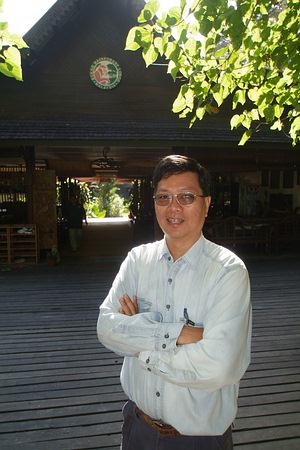
 A
graduate in Economics from the University of London in 1977, Albert
Teo has been in the tourism industry for the last thirty years. Over
the three decades, he has been a hotelier, tour operator, lodge and
backpacker owner and operator.
A
graduate in Economics from the University of London in 1977, Albert
Teo has been in the tourism industry for the last thirty years. Over
the three decades, he has been a hotelier, tour operator, lodge and
backpacker owner and operator.
A
keen photographer, he has trekked over 1,000km in Borneo and published
over 150 postcards designs of Borneo and seven books including Sabah
-Land of the Sacred Mountain, Journey through Borneo, Saving
Paradise-The Story of Sukau Rainforest Lodge among others.
His
companies Borneo Eco Tours and Sukau
Rainforest Lodge have won numerous international ecotourism
awards. Sukau Rainforest Lodge was Highly Commended in the Best Small
Hotel / Accommodation category of the
First Choice Responsible
Tourism Awards.
The success of Sukau Rainforest Lodge has encouraged him to share his
experience of running the lodge in Saving Paradise which he
co-authored with fellow ECOCLUB Member Carol Patterson in 2005 and
which documented the ten years of operation of the lodge.
Over
the last few years, Albert Teo has organized three highly successful
international ecotourism conferences in Malaysia including the World
Ecotourism Conference and Field Trips in 1999, the 1st Asia Pacific
Ecotourism Conference APeco2002 and Borneo Ecotourism Conference in
2005. He will be organizing the Borneo Tourism Conference BTC2007 with
Professor Ross Dowling of Edith Cowan University, Australia in
September 2007.
Albert has served in various positions in the tourism industry
including Sabah Chapter Chairman of Malaysian Association of Tours and
Travel Agents MATTA, Chairman of Sabah Tourist Association, Advisor of
The International Ecotourism Society, USA, and marketing committee of
Sabah Tourism Board among others.
In
the last few years Albert started to travel around the Asia Pacific
countries as an ecotourism speaker on ecotour and ecolodge operations
and marketing through his consulting company, Borneo Integrated
Services Pte Ltd. In October 2006, Albert was recognized by Edith
Cowan University, Australia for his contribution to the university
where he was appointed as the Adjunct Lecturer for three years.
(The Interview follows:)
 ECOCLUB:
In what way is Ecotourism better understood and practised today in
Malaysia , compared to when you started, 30 years - a generation -
ago? Have domestic and foreign tourists perception and attitudes
changed in a significant way?
ECOCLUB:
In what way is Ecotourism better understood and practised today in
Malaysia , compared to when you started, 30 years - a generation -
ago? Have domestic and foreign tourists perception and attitudes
changed in a significant way?
Albert Teo: We are very fortunate to have in place Malaysia
Ecotourism Plan which was done in the mid 90s and used by the
government to guide their developments. As a result ecotourism is
better understood by the serious practitioners including academics,
NGOs including WWF which assisted the government in drafting the
ecotourism master plan, government departments directly responsible
for developing ecotourism and a few special interest tour and lodge
operators. Many tourism players have also been exposed to ecotourism
through several international ecotourism conferences that I have
organised under Malaysian Association of Tours and Travel Agents MATTA
including World Ecotourism Conference WEC1999, Asia Pacific Ecotourism
Conference APeco2002, Borneo Ecotourism Conference BEC2005 and the
forthcoming Borneo Tourism Conference BTC2007 in September 2007. Over
the last few years, MATTA have also been organising the bi-annual
APeco conference in different parts of the country. The general level
of understanding among Malaysians in the tourism industry is therefore
increasing though at a slower pace than the foreign tourists
especially those who choose to come to Malaysian Borneo states of
Sabah and Sarawak where ecotourism products are more varied and better
developed.
ECOCLUB:
Your book, co-authored with Carol Patterson, on Sukau bravely
informs the readers about some of the challenges you faced, and
indirectly indicates some of the weaknesses. How easy was it for you
as a business person to reveal some of your secrets? And how
transparent can Lodge and Tour Operators really be, in their quest to
safeguard their reputation from competitors and malicious others?
Albert Teo: I have personally acquired most of my knowledge on
ecotourism through books that I read and have been asked countless
times to share my experiences by potential investors, developers and
tourists alike. I have also seen many mistakes and countless cases of
wasted funds from people who did not understand the challenges and
level of commitment required before they started their projects.
My book
is to give them an idea of the potentials and pitfalls for them to
check themselves whether they really have the skills, funds and
stamina to do this type of business. This business is not for everyone
and is full of challenges. I hope my book will help those who are
genuinely serious in doing this business so that the country will
benefit from better ecotourism products and raise our standard.
I also
indicated that some of the government policies were anti-poverty
policies although this was not their intention but unfortunately it is
the case. More private investments would have taken place in rural
areas with potential for employment opportunities in ecotourism
products if not for restrictive land and bank lending policies.
If I
don’t speak out on the problems and challenges that I have
encountered, we will not be able to change and improve nor overcome
the challenges. I understand that some policies are in place due
mostly to insecurity. Given the rapid pace of globalisation and the
shift towards knowledge economy, I am afraid the old perception that
land ownership being most important is depriving the rural people of
investment opportunities and thus of skills that they desperately need
to raise their self confidence and engage in the global economy to
reduce their dependency on government welfare programs.
At the
end of the day, given the power of internet and global presence, the
customer is the final judge and not our competitor. Our biggest
competitor will be ourselves, both individually and as a country.
Neither is knowledge static and with the power of internet, we can use
our knowledge through positioning our product as a brand. As
ecotourism is a niche market, the more we tell and the more people
know about our unique product, the more potent is the branding.
ECOCLUB:
You have won many prestigious
international tourism awards in your career, both personal, and for
your businesses. You are also a member of the jury for other awards.
So how important for business are major tourism awards, compared with
say certification? Do you feel major tourism awards are transparent
enough, or is there considerable ground for improvement?
Albert Teo:Awards are given based on certain criteria. It is also
a form of benchmarking for us whether our operations and products have
achieved a certain standard based on those criteria. Certification
does the same thing only that sometimes you have to pay a fair amount
of money which you will rather invest in improving the product.
I still
believe that awards give me more mileage in publicity than
certification especially when your products win several different
awards. However, certification is very useful especially when it can
help improve the system and save cost in the long run and improve
profitability.
Just as
business can be improved, so also tourism awards criteria. For
example, criteria should be designed in such a way that a billion
dollar chain hotel company in a developed country does not compete
unfairly with an independent small Ecolodge operation in a third world
country. So also a giant tour company employing 2,000 employees
compete with 20-person company.
ECOCLUB:
With Sukau you have made a miracle in developing a world class
Ecolodge in what was not really a virgin environment, as primary
vegetation had been destroyed mainly for plantations, while also
engaging in major reforestation projects. Forest fires are of course a
major problem, in your neighbours Indonesia. Do you see Ecotourism as
a realistic way of stopping forest fires, forestry and plantation
expansion in the broader region, or practically as a neutral add-on?
Albert Teo: With Sukau Rainforest Lodge, we are trying to create a
unique travel experience with limited funds. We are trying to use the
lodge as a tool for educating the locals and tourists alike on the
idea of practising a more sustainable living and sustainable
development; that they is value in preserving the natural environment
including the wildlife such as Borneo pygmy elephants, orang utans and
proboscis and the other primates in Sukau; that maximum land
utilisation need not be at the expense of wildlife and the natural
environment; that locals prefer to work in tourism enterprises instead
of in palm oil plantations; that there is a place for commercial oil
palm plantations and also ecotourism business and they need to
co-exist in some areas.
So they
cannot cut the native vegetation right to the river's edges as
stipulated by law which affects wildlife viewing and migration.
Reforestation is not only expensive but also hard due to the compacted
ground as we have found out in our Kinabatangan wildlife corridor
rehabilitation project KWICORP.
As
Malaysians become more affluent, they will want to seek out places
like Sukau for their spiritual encounters with wild orang utans, wild
elephants and wild proboscis monkeys and generally with nature and we
need to protect the area for our future generations to enjoy.
Ecotourism will not stop the fire and global expansion of palm oil so
long as there is a market for them but it will raise the consciousness
of both the government and all the other stakeholders on the need to
enforce our existing laws, that the development of one industry
stakeholder cannot be at the expense of the other stakeholders.
ECOCLUB:
A most successful eco-entrepreneur, you have rightfully ventured
into the consultancy field. Does this create any ethical dilemmas or
conflicts of interest? For example, what would you say to clients
requesting advice for Golf & luxury tourism developments in Malaysia?
Would you try to direct them towards Ecotourism, or do you see merits
in those type of developments as well?
Albert Teo: Ecotourism may not be feasible in all areas. It all
depends on the resources available in the area concerned. For any
business to be sustainable in the long term, we have to look at the
triple bottom line, social, environmental and economic and all
developments should include three areas concerned. This is very
challenging naturally as will become more so as pristine resources
become more scarce. There may be a place for golf and luxury lodges
then depending on the marketing segments we want to tap and the USP of
the area.
ECOCLUB:
You have great experience in organising and hosting Ecotourism
Conferences. Beyond the topic, what is needed to make such conferences
truly "Eco"? And how satisfied are you with the amount and level of
discourse about Ecotourism at the global level today?
Albert Teo: I am tempted to suggest that we should do more local
conferences and less international conference so as to minimize the
need to fly long distances. I have attended a few conferences where
some delegates come for two days half way round the world. We may be
able to afford to fly but the cost to the environment has not been
taken into account. I have taken this step by focusing now on just
organising a regional/local conference to minimise the need to travel
long distance.
For
those in the know, there is an increasing number of organisations
producing ecotourism and sustainable tourism newsletter. The level of
consciousness is growing and is picking up in momentum with the
growing interest in global warming and global warning through the
increasing frequency in natural calamities.
ECOCLUB:
How satisfied are you with the public sector's approach in terms
of physical and legal infrastructure, and appropriate funding in
Malaysia. Did such state assistance play any significant role in your
business?
Albert Teo: While I learned to live with and adjust my
expectation, it is natural for any private entrepreneur to move faster
than what is possible. The bigger the project, the longer is the
decision-making process and implementation process and the government
is no exception.
Unfortunately, this does result in implementation of policies which
though they have good intention come too late. Though we have our
hiccups, Malaysia has done pretty well with five year plans and the
government has been pro-active in many instances too including
providing loans with lower interest and tax free holidays have been
granted to investors and tourism companies.
ECOCLUB:
If you could name just one ingredient of the recipe for a
successful Ecolodge, what would it be?
Albert Teo: Keep improving and don’t quit.
ECOCLUB:
How easy and how important have you found cooperation with NGOs in the
course of conducting your ecotourism business? Do you feel that
dividing lines between "for-profits" and "non-profits" are perhaps
becoming more difficult to detect in the ecotourism world, and would
that be a good or a bad thing?
Albert Teo: We enjoy working with many NGOs. The disadvantage NGOs
have over us is that they have a time line and strict agenda and this
lack of continuity is often a cause for disillusionment for the local
community whose hopes have been raised high only to be abandoned when
the project or funds runs out. Capacity building does take at least
ten years to bear fruit and it is therefore vital NGOs work with
organisations that have long term presence in the local area to ensure
momentum is not lost and earlier investment is not wasted.
ECOCLUB:
Is there anything else you would like to say to our Members and
readers, or perhaps about your future plans?
Albert Teo: I have made a lot of mistakes in the past and still
continue to learn. I want to make the best of my knowledge and time by
looking for strategic partners and by sharing my knowledge. I am
hoping to put all these together by creating a new model ecolodge as
best I can with partners and specialists as a legacy for the future
generations.
ECOCLUB:
Thank you very much
 Find the complete
list of ECOCLUB Interviews here
Find the complete
list of ECOCLUB Interviews here

