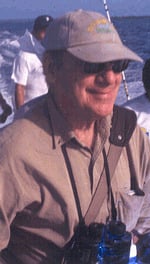
Ahead
of his time, in 1983 Mexican Architect Héctor Ceballos-Lascuráin
coined the term "ecotourism" and its preliminary definition, while his
modified version of the term was officially adopted by IUCN (The World
Conservation Union) in 1996. Today, as a famous environmentalist,
architect, and of course an Ecotourism expert, he is the Director
General of the Programme of International Consultancy on Ecotourism (PICE),
a Special Advisor on Ecotourism to IUCN (The World Conservation
Union), as well as Advisor to the United Nations World Tourism
Organization (UNWTO).
Héctor
Ceballos-Lascuráin is an expert in the planning and development of
sustainable tourism, ecotourism, park management, and
environmentally-friendly architectural design, with worldwide
experience in this field. He has carried out consultancy and research
work in 72 countries, including physical planning and low-impact
architectural projects for ecotourism, sustainable tourism facilities,
and housing developments, collaborating with governments, NGOs and
private firms in those countries, as well as international
institutions such as UNDP, UNEP, FAO, World Bank, OAS, World Tourism
Organization, IUCN, WWF, US-AID, IDB, TIES, PATA, NAFTA, Conservation
International, National Geographic Society, German Technical
Cooperation Agency, etc. He has spoken in conferences and symposia in
over 35 countries, and developed the National Ecotourism Strategies of
Mexico, Malaysia, Uruguay, Ecuador, Dominica, and Yemen.
Previously he was Director General of Standards and Technology of the
Mexican Ministry of Urban Development and Ecology (SEDUE) and
Protected Areas Program Coordinator of IUCN (World Conservation
Union), the latter with headquarters in Switzerland. For IUCN he
coordinated the IV World Parks Congress, held in Caracas, Venezuela,
in February 1992, an event attended by 1,800 persons from 130
countries. In 1981, he was the founding president of the Mexican
Association for the Conservation of Nature (PRONATURA), currently the
largest and most influential Mexican NGO in the field of conservation.
In 1984 he founded the first Mexican ecotourism agency: ECOTOURS.
He is
particularly interested in the interrelationship between ecology,
tourism, regional development, local communities, conservation, and
environmentally-responsible architecture, subjects on which he is the
author or co-author of over 120 titles. His 315-page book on "Tourism,
Ecotourism, and Protected Areas" was published in 1996 by IUCN. At
present, there are over 20,000 references to his work in the Internet.
In 2004 he was awarded the first Colibri Ecotourism Lifetime
Achievement Award by Planeta.com and Canyon Travel. He is also keenly
interested in ornithology, bird watching and bird conservation, and
has identified to date 3,671 bird species in their natural habitat
around the world! (ranked number 158 in the world list of the American
Birding Association – ABA)
More
details about Arq. Héctor Ceballos-Lascuráin’s current projects can be
found at
http://www.ceballos-lascurain.com
(The Interview follows:)
 ECOCLUB.com:
You are both a very active and near-mythical figure within the
Ecotourism movement, as the person who first coined the term
'Ecotourism' in the early 1980s. Was it an accident? Did the fact that
you were an architect play a role?
ECOCLUB.com:
You are both a very active and near-mythical figure within the
Ecotourism movement, as the person who first coined the term
'Ecotourism' in the early 1980s. Was it an accident? Did the fact that
you were an architect play a role?
Héctor Ceballos-Lascuráin: No, it wasn’t an accident. Ever since I
was a child, I was keenly interested in the natural and cultural
environment around me. In the family trips with my parents and my
sister around Mexico, I fell in love with nature (especially birds)
and history and culture (especially the archaeology of the
pre-Hispanic cultures of my country: the Mayas, Aztecs, and Toltecs),
and as a young man I realized that trips to relatively undisturbed
natural areas could provide strong socio-economic benefits to the host
communities. Soon after that, I coined the term of ecotourism and its
preliminary definition. I believe that architects, by nature, should
be more concerned about the environment than most other professionals,
so maybe my profession did influence my pioneering role in ecotourism.
ECOCLUB.com:
How did you define Ecotourism in the 1980s, how would you define it
today, and how satisfied are you with the evolution of Ecotourism,
this past quarter-century?
Héctor Ceballos-Lascuráin: My definition in 1983 was: “Ecotourism
is that tourism that involves travelling to relatively undisturbed
natural areas with the specific object of studying, admiring and
enjoying the scenery and its wild plants and animals, as well as any
existing cultural aspects (both past and present) found in these
areas. Ecotourism implies a scientific, aesthetic or philosophical
approach, although the ‘ecotourist’ is not required to be a
professional scientist, artist or philosopher. The main point is that
the person who practices ecotourism has the opportunity of immersing
him or herself in nature in a way that most people cannot enjoy in
their routine, urban existences. This person will eventually acquire
an awareness and knowledge of the natural environment, together with
its cultural aspects, that will convert him into somebody keenly
involved in conservation issues” .
I
revised this preliminary definition in 1993 to: “Ecotourism is
environmentally responsible travel and visitation to relatively
undisturbed natural areas, in order to enjoy, study and appreciate
nature (and any accompanying cultural features - both past and
present), that promotes conservation, has low negative visitor impact,
and provides for beneficially active socio-economic involvement of
local populations". This definition was officially adopted by IUCN -
The World Conservation Union – in 1996. According to this definition,
ecotourism denotes nature tourism with a normative element. Also,
ecotourism should be seen as a component of sustainable tourism (which
should now embrace all types of tourism, including city and beach
tourism). In general, I may say that I am quite surprised and
satisfied with the evolution of Ecotourism since I coined the term
back in 1983. However, I am also concerned that the term has been
variously abused and misused in many places. In my own country,
Mexico, and in many others, I am sad to see that “ecotourism” is seen
mainly as adventure tourism and carrying out extreme sports in a more
or less natural environment, with little concern for conservation or
sustainable development issues.
ECOCLUB.com:
Ecological architecture is becoming more common, however what are the
major practical problems that need to be resolved if it is to become
mainstream in the tourism sector?
Héctor Ceballos-Lascuráin: My definition of Ecodesign is "any form
of design that, being integrated to the surrounding ecosystem,
minimizes its negative environmental impacts". Ecodesign and
“ecological architecture” imply a more harmonious relationship between
the building and its environment. New energy sources have to be
employed (solar, wind, biomass, etc.) in a wise way. Excessive waste
of resources must be avoided but, unfortunately, many people are still
not willing to renounce to air conditioning for example, although in
most cases a good ecodesign can enhance natural cross-ventilation,
complemented by a ceiling fan. Government agencies in each country
should demand a more environmentally-friendly approach to design and
construction in general.
ECOCLUB.com:
What are the dominant trends in eco-architecture today? Are there
different schools and different materials, and which one do you
espouse?
Héctor Ceballos-Lascuráin: An “eco-architect” should be more
humble when designing a building and not just trying to impose his
“ego” on the environment. Saving energy, minimizing waste and avoiding
toxic materials are the dominating trends today. I am particularly
interested in liberating architectural forms from conventional cubes
and rectangles. Most of my designs are “organic” in shape, with
free-flowing lines which harmonize more easily with nature and
generally provide more amiable spaces for human beings. There are two
different schools as regards building materials: one advocates using
exclusively (or mainly) locally available “natural” materials, such as
wood, stone, bamboo, thatch, unburnt clay (‘adobe’), etc.; the other
supports industrialized building materials, which will favour not
continuing to deplete the use of rare, local materials, and which are
easier to transport and assemble on-site. I believe a combination of
both approaches is the most appropriate. Each specific case must be
carefully studied. Recipes are not possible.
ECOCLUB.com:
What makes an Ecolodge, an Ecolodge, from the architects' point of
view?
Héctor Ceballos-Lascuráin: An Ecolodge should blend in with the
natural environment. It should not be imposed on nature, and should
not overwhelm it. I am always stressing that “the most important thing
about an ecolodge is that the ecolodge is not the most important
thing" (Ceballos-Lascurain, 1997), i.e., it is the quality of the
surrounding environment that most counts: the nearby natural and
cultural attractions - and the way ecotourism circuits are set up,
operated and marketed, also the way in which local populations are
actively involved in the process.
The
main reason for a tourist coming to an ecolodge is that it provides
the opportunity of being in close contact with nature (in some cases,
supplemented by interesting cultural elements).
At a
purist level an Ecolodge will offer a tourist an educational and
participatory experience, be developed and managed in an
environmentally sensitive manner and protect its operating
environment. An ecolodge is different from mainstream lodges, like
fishing and ski lodges and luxury retreats. It is the philosophy of
ecological sensitivity that must underlie, and ultimately define, each
operation. It is this philosophy that the client is seeking both from
the lodge operator and from government in their support of resource
conservation.
ECOCLUB.com:
To the dismay of many, there are many luxury lodges that promote
themselves as 'Ecolodges'. As an architect do you believe that luxury
and ecology are compatible in terms of Lodge features?
Héctor Ceballos-Lascuráin: A new concept of “luxury” must be
incorporated into the ecolodge field. Having the privilege of being
surrounded by a primeval rain forest or having the opportunity of
watching birds from your breakfast table, or being able to see a Maya
temple or and Indian pagoda from your lodge room, or staying at a
lodge which is one hundred per cent energy self-sufficient is
considered by ecotourists more of a “luxury” than staying at a hotel
with marble floors, state-of-the-art discotheques or air-conditioning.
ECOCLUB.com:
Mexico has a long and quite successful history of organised planning
for Tourism, the development of the Yucatan peninsula, where you have
worked, as a vast resort being a prime example. What in your view and
experience have been the major errors and lessons learned at a policy
level from Yucatan, and have these been adequately incorporated in
state policy?
Héctor Ceballos-Lascuráin: Unfortunately, the so-called official
project of the “Mundo Maya”, promoted by the Mexican and other Central
American governments, has failed as an instrument for local
sustainable development and for conservation of the natural
environment. This is due to the fact that the “Mundo Maya”, since its
inception in the early 90s, was seen only as a marketing gimmick and
an exceptional opportunity for making good business for transnational
companies (or rich hotel groups from Mexico City), and there was never
a serious sociological or ecological framework underlying the scheme.
Because of this, the project is slowly fading away, and the unique
opportunities for a true ecotourism project have not yet been grasped.
ECOCLUB.com:
Also in Mexico, protesting teachers in Oaxaca have recently blamed
among other things 'Yankee Ecotourism'. Is there something that needs
to be done perhaps, to reconnect Ecotourism with the public interest
and public perception in Mexico?
Héctor Ceballos-Lascuráin: Yes, the tourism authorities and the
ecotour operators themselves must try to involve the Mexican public in
more true ecotourism activities (and not only promoting high-adrenalin
activities such as jumping off cliffs with parachutes, cliff climbing
and rappel, and hang gliding). If we are going to conserve our rich
natural and cultural heritage for the coming generations we must
embrace tourism as a tool for conservation, for ensuring sustainable
development and for enhancing environmental awareness and ecological
education. Also, Ecotourism must not be seen as only something for the
rich foreigners.
ECOCLUB.com:
In many countries, certain circles are touting the need and benefits
from villa developments for affluent foreign owners, complete with
golf courses and marinas, and argue that these can be made
sustainable, environmentally-friendly and beneficial for the local
economy. Do you agree?
Héctor Ceballos-Lascuráin: If this development is truly going to
be sustainable, respecting the natural and cultural environment and
improving the livelihood of local inhabitants, I agree. However, most
“exclusive villas”, golf courses and marinas are still carried out in
an environmentally-unfriendly way and they generally foster an
“enclave” approach, which usually means putting a wall between the
tourism or real estate facility and the surrounding environment and
communities. The inhabitant of these “pleasure domes” will normally
not have the opportunity of truly relating to the environment of a
specific country or region and the surrounding poor people will in all
likelihood remain poor, marginalized from this process.
ECOCLUB.com:
You have worked as an architect and consultant in virtually all parts
of the planet, learning and teaching. However some purists /
nationalists even, would argue that it is not so 'eco' for developers
to use foreign architects, but to rely on local 'wisdom' , 'talent'
and 'tradition' when creating tourism facilities. What would you say
to them?
Héctor Ceballos-Lascuráin: Since Ecotourism is a new, complex and
inter-disciplinary phenomenon (with a “globalization” component), in
most developing countries it is usually not enough to rely on local
wisdom, talent and tradition, at least in the present time. The
insight of an international consultant or architect , with much
grass-roots experience in many diverse countries around the world,
should continue contributing tangible benefits to local ecotourism and
ecolodge projects, as long as the consultant respects the local
environment (both natural and cultural) and is willing to work within
a team of local professionals and other stakeholders. Perhaps in the
future, once ecotourism is clearly understood around the world, the
need for foreign architects and consultants will not be further
required.
ECOCLUB.com:
You have probably already achieved all your architectural ambitions,
still, if a government or development was to give you a blank cheque
to build anything you like, anywhere you like, what & where would it
be?
Héctor Ceballos-Lascuráin: At this stage of my professional
development, I am mainly turning my attention to my country, Mexico,
where there is still much to be done in the field of true Ecotourism
and environmental architecture development. Fortunately, I have
recently been engaged by two important urban developers who are
planning two megaprojects in different parts of Mexico in suburban
areas of two big cities (both involving more than 50,000 houses each –
they are really being conceived as new cities). In both projects, the
developers have decided that over 20 per cent of the total land will
be left as a natural reserve, in which only ecotourism and other
environmentally-friendly activities will be allowed to be carried out.
My involvement in these two megaprojects is both as an architectural
designer and as an ecotourism consultant, an I will be developing the
master plan of the natural areas, including ecolodges, nature trails,
interpretative centres, experimental ecological farms, display areas
for alternative technologies, wellness retreats and a number of
exclusive upmarket “ecological residences” (placed on the buffer zone
of the protected natural areas). God willing, these two projects (in
which I hope to be involved over the next 5 or more years) could well
be my dream projects and my “blank cheques”.
ECOCLUB.com:
Thank you very much
 Find the complete
list of ECOCLUB Interviews here
Find the complete
list of ECOCLUB Interviews here