Ariane Janér:
Brazil Sustainable Tourism Program, Instituto de
Hospitalidade & EcoBrasil
"The
construction of big resorts or fast growing tourism destinations in
previously sparsely inhabited areas can directly lead to "favelization"
of the surrounding areas"
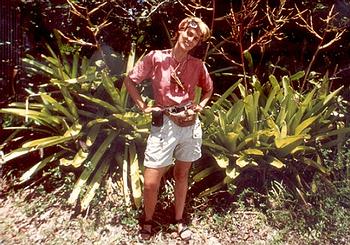 Ariane
Janér is a Dutch zoologist (MSc Leiden) with a degree in business
administration (MBA Delft, who has been living in Brazil since 1988
and working in the area of sustainable development since 1991. She has
consulted many ecotourism projects in Brazil and also helps develop
practical training courses. Ariane builds on her experience in
marketing and finance acquired through a career at Royal Dutch Shell,
as a freelance consumer market researcher for Euromonitor, as a
financial analyst for Baxter Straub and as owner/director of an
ecotourism operator. She is at present responsible for the marketing
activities of the Brazil Sustainable Tourism Program (PCTS) coordinated by the
Instituto de Hospitalidade. She is one of the co-founders and still
actively involved with
EcoBrasil, the
Brazilian Ecotourism Society.
Ariane
Janér is a Dutch zoologist (MSc Leiden) with a degree in business
administration (MBA Delft, who has been living in Brazil since 1988
and working in the area of sustainable development since 1991. She has
consulted many ecotourism projects in Brazil and also helps develop
practical training courses. Ariane builds on her experience in
marketing and finance acquired through a career at Royal Dutch Shell,
as a freelance consumer market researcher for Euromonitor, as a
financial analyst for Baxter Straub and as owner/director of an
ecotourism operator. She is at present responsible for the marketing
activities of the Brazil Sustainable Tourism Program (PCTS) coordinated by the
Instituto de Hospitalidade. She is one of the co-founders and still
actively involved with
EcoBrasil, the
Brazilian Ecotourism Society.
Instituto de Hospitalidade (IH) is a national, non-profit,
non-government organization dedicated to the promotion of sustainable
tourism as a tool to promote economic and social development, cultural
diversity, and the preservation of our biodiversity. The Institute
pursues a variety of projects in partnership with Brazilian,
international and multilateral organizations that specialize in
educational, labour, cultural, environmental and tourism industry
endeavours. Launched in 1997 with support from 32 corporate,
governmental and Third Sector organizations, and established in
Salvador (Bahia), Brazil, IH has developed, implemented and managed
dozens of successful projects throughout Brazil. EcoBrasil was founded
in 1993 with a vision for helping develop Brazil as a reliable
destination for ecotourism through the exchange of information and
developing and participating in innovative projects. Since then
EcoBrasil has been involved in many initiatives in Brasil, most
recently the Best Practices in Ecotourism Project, created in
partnership with Funbio.
(The Interview follows:)
 ECOCLUB:
Prospective eco-sensitive visitors to Brazil grew up hearing sad
stories about the destruction of the Brazilian rainforest, the plight
of the indigenous and the murder of concerned activists. Can you or
the government promise to ecotourists, that beyond decrees to expand
National Parks and create more protected areas that the situation has
really changed on the ground, in recent years?
ECOCLUB:
Prospective eco-sensitive visitors to Brazil grew up hearing sad
stories about the destruction of the Brazilian rainforest, the plight
of the indigenous and the murder of concerned activists. Can you or
the government promise to ecotourists, that beyond decrees to expand
National Parks and create more protected areas that the situation has
really changed on the ground, in recent years?
Ariane Janér: No, I think nobody can promise that. There are
complex forces at play in the destruction and protection of the
Amazon. I can point to promising examples like Mamiraua in the Amazon
basin (a large scale NGO led project with active community
participation), Cristalino Jungle Lodge in the Southern Amazon
(private enterprise inspiring government) or ARPA - Amazon Protected
Areas Project (a public-private/NGO partnership) and small community
initiatives, but unfortunately they are not enough.
We should remember that economic success is measured in GDP and GDP
does not differentiate if you generate income by destroying your
natural capital or if you generate income by earning "interest" on
your natural capital. With China as the next "thirsty" elephant at the
world's table, even more forest in the transition zones between the
water rich Cerrado and the Amazon is cleared for soy plantations,
pushing smaller landowners further inside the Amazon. And Biodiesel,
far from being a miracle solution to energy problems, will also
stimulate further land clearance.
Unfortunately, the economic contribution of successful ecotourism
is very small compared to international pressures for more resources
to fuel the world economy. Unfortunate indeed as when you clear the
Amazon you will change rainfall patterns in an area that will go from
Argentina to the Southern United States. Some scientists have already
pointed out that is was no coincidence that there was a record
hurricane season in the Caribbean and a record drought in the Amazon
last year ....
Don't get me wrong, locally ecotourism can have tremendous impact,
but there are just not enough ecotourists to save the Amazon. What is
needed for saving the Amazon is the recognition of the ecosystem value
of the forest standing and a effective compensation system to make
sure that the forest remains intact. For this a paradigm shift is
needed in the way the world measures economic progress.
And, of course, we should all be starting to eat less meat so our
ecological footprint reduces.
In
a 2004 speech Brazilian President Lula stated that sustainable tourism
"can lift the self-esteem of communities when they see the value to
others of their heritage, culture and way of life". But are there
enough tours that really show tourists the real heritage, culture and
way of life / standard of living of Brazilian communities, or do
tourists still see (& want to see) the glossy Brazil? And how
satisfied are you with national tourism policy towards sustainable
tourism?
Supply usually follows demand. There are enough tours in Brazil for
people who want to go further inside the country and experience an
authentic Brazil. However, demand is very small still and some of the
suppliers offering special interest tourism are struggling to make
ends meet.
Sun & sea is still the dominating segment of tourism the world
over, and these beach tourists are the easiest to attract, so that is
where the short term smart money is going : a large part of Brazil's
growth in tourism in recent years has to do with cheap charter flights
to the beaches in the Northeast.
Despite the fact that Lula mentioned sustainable tourism in his
speech, the Brazil international marketing plan hardly touches on the
subject. There are plenty of people working for sustainable tourism
both within the government and in the private sector, but there is no
consistent national tourism policy towards sustainable tourism and
Brazil as yet is using simple indicators such as number of tourists
and tourism receipts to measure success. So the road towards
sustainable tourism is a long one.
Even
people who have not been to Brazil know about the infamous favelas.
Has sustainable tourism, so far been in any way relevant for the
people in these favelas, beyond say the creation of menial jobs? Could
you mention some successful tourism projects that really made change?
In the first place, it is difficult to generalize about favelas,
they are different by suburb, city and region of the country. In Rio,
one could argue that they are partly the result of poor housing
policies and the "cost" of long job commutes from the suburbs. Part of
the people who live in favelas, especially in those with good
locations, can be considered lower middle-class. When I recently
checked the price of a room in the Rocinha favela (which is all brick
and mortar - not cardboard shacks), close to where I live, it was very
similar to the price of a one room apartment in the nearby Leblon
neighbourhood. I am not trying to say that favelas have no problems
(they certainly do and they are especially linked to drug-crime).
In Rio, Rocinha and other favelas have been receiving favela tours
for more than 10 years, with direct involvement of the community. And
in general I would think that those located close to tourism areas,
will have profited from tourism. But the favelas in Rio depend on the
economics of a big city not just tourism.
On the other hand, the construction of big resorts or fast growing
tourism destinations in previously sparsely inhabited areas can
directly lead to "favelization" of the surrounding areas, as tourism
planners forget about proper housing conditions for workers and how to
deal with tourism related migration (from rural to urban areas).
Was
indifference, ignorance, or some other obstacle a bigger challenge
when the Sustainable Tourism Certification Program of Brazil (PCTS)
was first launched and during its implementation? What would be
important milestones and lessons learned so far?
I would say that the main obstacles are a combination of too high
expectations (of how easy it is to shift the paradigm to thinking
sustainably) and too many agendas (of what people want to use
sustainable tourism concepts for).
By studying other programs, we managed to absorb some of their
lessons learnt such as having adequate funding, investing in
partnerships and international networking and not forgetting how
important capacity building and marketing are.
Important milestones were coming to an agreement with the CBTS
(Brazilian Sustainable Stewardship Council - an initiative led by the
environmental NGO sector) on working together on a developing
standards in a modular way, starting with the accommodation sector;
linking into international networks (such as the Network for the
Americas) and of course developing the standard in a more than a year
long participatory process. The standard is now close to being
approved as an official Brazilian standard (which will facilitate
further government support) and we are implementing by destinations.
There are no companies certified yet, as our priority is not
certification but creating a critical mass and an awareness of the
advantages of sustainable tourism practices. That is where we are now:
working with tourism enterprises and destinations to implement
sustainable practices.
The most important milestone, however, is still far away and that
is making sustainable tourism a mainstream concept. All tourism
planners should realize that there is no quality tourism and no
sustainable growth in tourism without incorporating sustainable
tourism practices.
The
stereotypical tourist visits Copacabana, Bahia, the Iguacu falls, the
meeting of the waters in the Amazon and lately, perhaps include a
Fazenda in the Pantanal. But what proportion of Brazil’s visitors
really care about environmental, social and sustainable issues? Is
this percentage growing over the years and what in your view could
Brazil do for it to grow faster?
Yes, the classic tour of Brazil is Rio, Foz, Salvador & Bahia and
the Amazon (and the Pantanal). However, all these wonderful
destinations not only have the bog standard product, but also a lot of
alternative products for those who want something completely
different. Rio is a city with true natural charm and one of Brazil's
great adventure centres (hiking, climbing, surfing, sailing,
horseriding, biking, hanggliding ... you can do it all in Rio. You
can stay in the Copacabana Palace and dine in fancy restaurants or in
a B&B in the favela and do volunteer work and everything in between.
Both Foz (revitalization of National Park with a host of new
activities and products) and Salvador (restoration of Historic Centre
and cultural revival) have invested in repositioning their product.
The Pantanal probably already rivals the Amazon in number of foreign
tourists.
Of course, Brazil does not have a lack of other great places to go.
That is the problem with a country the size of a continent. I
personally think that Brazil should market itself by region and that
tourists should not try to jet all over Brazil to see the highlights,
but concentrate on one or two regions.
I don't have any good statistics or attitude research, but I think
that most tourists who visit the interior care about these issues. The
important thing is that Brazil also shows it cares about keeping
itself a wonderful destination.
And
what about domestic tourism? Brazil has a growing middle class that
likes to explore its vast homeland on weekends, are they adequately
eco-minded in your view?
The Brazilian domestic market is huge. With the exception of the
Amazon, in most ecotourism destinations you will find more Brazilians
visiting than foreigners. According to the first results of the 2006
Domestic Tourism Study (Embratur/Fipe), nearly half of the Brazilian
population travels and more than 80% of these travel for leisure
reasons. The study also shows that 15% of travellers enjoy visiting
natural attractions and 6% (ranging from 3% in the lower income
classes to 10% in the higher income classes) of the travellers
consider themselves ecotourists.
Since the 80s the environmental (and social) movements have been
quite successful in getting eco-messages across: you can see this
clearly in the number of serious NGOs, NGO membership, consumption of
organic and natural food, recycling, mobilization for environmental
issues etc. Of course, in Brazil, consumers have less disposable
income and cannot always make the eco-choice even if they would like
to. And of course, I would like to see even more people become
eco-conscious, but that also goes for other parts of the world.
Private
Natural Heritage Reserves (RPPNs) in Brazil, are touted as an
alternative solution for large landowners who can get tax breaks in
return for (promising to) not to cut down the forest, and engage
instead in tourism, pharmaceutical research, and environmental
education. Does this just create 'islands' of private wealth in a sea
of public poverty and landlessness, or is it actually working? Has
sustainable tourism in Brazil stopped the destruction of Brazilian
forests or merely decreased the rate of destruction? Can your
institution monitor that private landowners stick to their word? And
does your institution favour private, public or community ownership of
tourism's natural resources?
The view on RPPNs seems a bit distorted to me. In the first place
many are relatively small and not created by large landowners. In
December 2005 there were 425 registered RPPNs with an average size of
1000 ha (in Brazilian terms this is not a large area). There are a few
really big ones (but in areas like the Pantanal or the Amazon, where
it makes sense) and a lot of small ones. In the second place the
advantages in terms of tax breaks, preferred treatment for financing
etc. are not that attractive in practice. In return you need to invest
in a management plan and consult with IBAMA (RPPNs are overseen by
IBAMA and not by the Instituto de Hospitalidade or EcoBrasil) if you
want to do anything in your reserve. All the RPPNs I know were created
by serious people or insitutions, who could have made more money by
selling or developing their land.
I cannot speak for my institution about favouring a type of
ownership. Personally, I believe that there is not one right model, it
depends on the local situation. The key thing is that somebody, be it
community, private owner, government or destination stewards must feel
that you don’t really own things, you just have to take good care of
natural and cultural assets, so you can pass them on for future
generations to enjoy.
Manaus
is historically synonymous with boom and bust, with reference to the
rubber rush of the early 20th century, with its magnificent Opera
House a testament to past glory. Some say, the story is being
repeated, in terms of the Jungle lodges that once proliferated, but
are since not faring that well, with tourism in Manaus falling by 40%
in recent years. Given that Manaus is at the heart of the world’s
lungs, the vast Amazon rainforest, is this development worrying for
sustainable tourism? What is wrong? Not enough authenticity? Not
enough local participation? Violent crime? Negative environmental
publicity? Competition from the Pantanal?
To me the Amazon is not the world's lungs (mature rainforests are
not net oxygen producers), but the world's "sponge" (the region is
very important for its climate control - watershed - rainfall
function). Yes, tourism dropped in the nineties from a high in 1989
and some lodges closed. However, the past few years tourism has been
on the rise again and there has been a lot of new investment lately.
But, as I said before, growth of beach tourism is stronger.
And yes, competition from other destinations is an issue. Demand is
now spread over a greater number of destinations. Manaus does have an
image problem as a bit of a tourist trap and an "old destination". The
Amazon is huge and there are other great places to go like in the
Amazon like Belém, Santarém, Cristalino, Mamiraua, Vale do Guaporé,
Amapá, Tocantins and there are more than a hundred eco-destinations to
go in Brazil, which are not in the Amazon, but have a magic all their
own.
The
carnival & beach culture of Brazil is a big attraction; however it
also results in sex tourism. Recently there has been a wave of tourist
arrests in Natal related to sex tourism. What are your thoughts /
actions on this sensitive issue?
True and this is not a new issue. This is one of the "public costs"
of attracting tourists with cheap charter flights and it should have
been no surprise as we saw this starting in Recife years ago, when
they started as a charter destination. As one of the incoming tour
operators in Natal explained it to me, the sex tourism is detrimental
to her mainstream tourism business, as her market is families with
children, who do not enjoy coming face with the sex trade in the same
hotels and restaurants they visit.
Brazil already has a National Campaign against Sex Tourism, but
actions on the ground have been timid. However, you should remember
that prostitution is not illegal in Brazil (though promoting sex
tourism and having sex with minors is). The arrests are a sign that
the government is clamping down and we hope they keep it up. However,
prevention is always better a remedy and thinking sustainable tourism
from the beginning might have avoided underestimating the problem.
Even
if competition to attract ‘wealthy foreigners’ is fierce and very
visible in the world’s large travel fairs, this being a form of
economic nationalism, internationalism, cooperation among neighbouring
countries is also paramount when it comes to protecting shared
resources, reducing poverty and migration. Do any notable cross-border
initiatives exist in Brazil in the sphere of sustainable tourism?
I have been to workshops for the greater Amazon region, there are
parks like Iguaçu (Brazil) and Iguazu (Misiones, Argentina) or
corridors like the Guaporé Valley (Brazil and Bolivia) that form one
area. In sustainable tourism we are talking both through the Network
of the Americas (led by Rainforest Alliance) and other channels to
neighbouring countries, but I think there are so many urgent things to
do nationally (plus frequent changes in government policies in other
countries) that it is more talk than action at the moment. But I
personally would love to see cross-border tourism development like
training, cross-border parks and itineraries take off.
And
finally, Brazil is the birthplace and an enthusiastic host to World
Social Forum meetings, (themselves a form of social tourism). So, do
you see Sustainable Tourism in Brazil remaining politically neutral,
concerned with environmental conservation, or do you feel it will
become a movement ‘for another tourism’?
You might find it interesting to know that there is another World
Forum in Brazil: the
World Tourism Forum for Peace and Sustainable
Development, which will hold its 3rd annual
summit in Porto Alegre at the end of this year. The Instituto de
Hospitalidade coordinates this event for Brazil's Ministry of Tourism
and the UN.
Coming back to the Sustainable Tourism Program : our standards
consider 3 dimensions : environmental, social-cultural and economic.
The idea behind the program is that there is no quality tourism
without sustainability inside. We believe that all types of tourism
should adopt sustainable practices and therefore our program is
politically neutral. Personally, I think a movement for "another
tourism" is important for the diversity and evolution of tourism.
ECOCLUB:
Thank you very much
 For more
information
contact
Ms Ariane Janér by email
For more
information
contact
Ms Ariane Janér by email
 Find the complete
list of ECOCLUB Interviews here
Find the complete
list of ECOCLUB Interviews here

