|
|
||||
|
ISSN 1108-8931 |
INTERNATIONAL ECOTOURISM MONTHLY |
Year 5-Issue 53, Oct 2003 |
||
|
Download this issue in PDF
Form (400 KB) Ms Eleni Svoronou
WWF
Greece, an independent national organisation of the WWF
international network, was founded in 1990. Its mission is the
conservation of the Greek natural heritage. WWF Greece works on
multiple levels including (a) field work in selected ecologically
sensitive areas, (b) advocacy and policy work and (c) awareness,
communication and environmental education. WWF Greece, with the
support of its approximately 15.000 active members, has achieved major
successes, such as the protection of endangered species and habitats
under threat, the halt of destructive development projects. It has
also contributed in the rationalisation of the management of Greek
protected areas. WWF Greece views and uses Ecotourism as a means of
conservation and as an alternative to unsustainable development of
protected areas.
|
||||
|
E. Svoronou: I would
choose the most long term achievements, the ones that are less visible
and, unfortunately, the most difficult to communicate to people:
E. Svoronou: The
questions are very relevant at this initial stage of the Natura 2000
network and the National Parks in Greece. To answer the first question
about what is happening today, I would say that up until now Protected
Areas were not protected in a systematic way. I do not mean that there
was no protection at all. But protection fell into the responsibility
of different competent authorities, there were no coherent management
plans, guarding systems and conservation strategies. As a result, the
degree of protection depended upon the specific conditions of each
Protected Area. The general picture is that Protected Areas were
insufficiently protected from all the threats you mentioned. Illegal
hunting, illegal building, road construction, and, in general,
uncontrolled development (often related to tourism) are the commonest
threats. The laws to protect the environment exist. The implementation
of the laws is the problem. In the Marine National Park of Zakynthos,
to give one example, there are still illegal buildings in the habitat
of the sea turtle, Caretta.
E. Svoronou: Horses, if properly managed, Trojan horses if left in the "law of the market". With the recent trend of ecotourism, tourism in Protected Areas has increased. It is mainly Greek tourists who visit these areas in the mainland. Fortunately, the numbers are not frightening. The 50.000 annual tourists in the Dadia forest do not compare to the 600.000 tourists of the Marine National Park of Zakynthos! The mainland is still relatively safe from a large influx of tourism. However, even these relatively small numbers, if not managed properly, can become a threat. What is more important, is to prevent the uncontrolled development that even a few tourists can stimulate. Hotel and rooms construction has to be rationalised. Environmental standards in tourism infrastructure have to be introduced in the tourism business sector. Visitor management tools have to be applied. Marketing and "de-marketing" policies to address seasonality have to be thought of. Capacity building opportunities for local communities have to be developed. If we start thinking and acting about all these aspects of tourism in Protected Areas, we might head towards the right direction, towards the "on horses" and not the "Trojan horses" role of tourists.
E. Svoronou: It is amazing how much widespread is this story about ecologists releasing wolves and snakes! As if ecologists could put wolves in a bag and release them in nature! The fact that these stories are believed by many locals shows that there is still a mistrust towards the "ecologists". The mere word "ecologist" in Greece has a negative overtone. It describes conservationists as fanatical people who care for nature and hate people. It is true in the past the conservation movement made mistakes. It did not take enough into consideration the human aspect of nature conservation. Now things have changed. We talk about people and nature, about sustainable development, not about the pelicans and the black vultures. And if we do talk about them, we use them as "indicators" for a healthy ecosystem where man and nature are in harmony. Still, however, we have not found the proper "language" to communicate with local communities. Every local community and every sector of local community has its own values, needs and fears. We have to understand them and "put ourselves in their shoes" before we communicate our conservation message. Very often it is a lack of time and resources that prevent us from doing this thorough investigation. Local communities are not homogenous and have varying attitudes towards ecology, conservation and protected areas. Not all of them believe in stories like the ones you mentioned. Some of them are asking to enlarge their Natura 2000 sites to include greater areas! Therefore, we have to work with every local community on the basis of their specific values, needs and fears.
E. Svoronou: We certainly cooperate, especially in major issues, like our campaign for the case of Schinias (against the construction of the rowing center for the Olympic Games), or the case of the Natura 2000, the establishment of the National Parks and the management bodies. WWF Greece takes an active role in coordinating the collaboration of NGOs in these campaigns. We believe in joining forces. On the other hand it is true we are competitors in raising funds from the government, the citizens, the European Union etc. It is a time of economic crisis and financial resources, especially from the private sector, are limited. Sometimes we join efforts there, too. We may collaborate on a project and submit it for funding by the E.U. In this case we collaborate mainly because we want to share expertise and secondly because we increase our chances to get the funding. No matter if "the pie" is limited and if it has to be cut in smaller pieces, we believe that each NGO has its own niche and expertise. At the end of the day, our final purpose is the environment and the sustainable development. Our survival as organisations is the means to this end, not an end in itself.
E. Svoronou: We might not have stopped the construction of the rowing centre altogether, but we have improved the plan considerably. Some of our proposals have been taken into consideration. The lesson learnt, in this case, in my opinion, is that our society still values development at any cost more than nature, history and quality of life. What could we have done better? This campaign, as you say, gained international support and still the project went on. The failure of the rowing centre to function properly due to strong winds, last August, proved we were right. The only lesson to be learnt is that our society has a long way to go before it places real ethical values and, after all, reason above the short term interests. Meanwhile we, NGOs, have a lot of work to do.
E. Svoronou: I was
wondering whether I should put it as one of the three successes of the
organization's work, so I am happy you raise this question now. WWF
Greece has worked systematically for the establishment of the Prespa
Park, which is a pioneering effort of collaboration between three
Balkan countries for the management of the Prespa wetland ecosystem.
The three countries are Albania, FYROM and Greece. The Prespa Park was
established in 2000 and the transnational coordination committee has
already started to work effectively and take action on the protection
of the common wetland. So it can be done! It requires a lot of effort
and in some cases transboundary collaboration for nature protection
might not be possible if political issues are very hot. We hope the
case of the Prespa Park will become a promising precedent for other
collaborations.
E. Svoronou: I will
speak for myself. As a Minister of Environment my Nr.1 priority would
be to rationalise the spatial development pattern, the land use and
building regulations throughout the country. Illegal building and
anarchy in spatial planning is a major problem. Since I do not know
enough about this complex issue, I will elaborate on my priority Nr. 2
which would be to make the 25 National Parks and their management
bodies work effectively. I would try to raise some funds to support
their start and I would make sure the management bodies start
prioritising their actions according the conservation needs of each
area. My initial action plan would include:
E. Svoronou: Our Volunteer Program is not for the urban, café-dwelling affluent youths. It is open to all youths. Especially in our summer camps, there are participants from all over the country. They live on very low budget, they share the everyday housework and they work together on a common task that involves manual work. Very few café-dwelling youths, of the mentality you imply, can give up their comforts. So, by definition, our volunteer camps address youths who are active, have an ideology, can share responsibilities and work together. No matter what is their background, we cultivate an ethos of living together, sharing and protecting the environment. Our volunteers come from all different parts of the country and they enjoy it a lot. Having said that, young people who are inhabitants of a Protected Area have less interest in spending some time of their holiday to work in the same area. It is natural that this type of activity is more attractive to young people from other areas who take the opportunity to get to know another part of Greece. But in terms of social and economic background, we have all kind of young people.
E. Svoronou: The cause I work for: people and environment. Mainly the fact that we have a philosophy that includes alleviation of poverty, equal distribution of wealth and natural resources, sustainable development, peace and respect to the "other". We envisage a different pattern of development of the world. What else is more rewarding than working for a cause and your personal ideology? Major source of motivation is also people: working with people of the same philosophy.
E. Svoronou: I will mention the plans of the capacity building initiative. Capacity building initiatives include workshops, seminars, "schools", publications etc. Our future plans include, among others, a 7-day school on wetland management and ecotourism. Anyone who is interested in getting more information about capacity building may contact us. Thank you very much and congratulations for this excellent work you do through ECOCLUB. It is based on solid views and ideas!
|
||||
|
Home|Ecolodges|News|Shop|Community|Chat|Library|Events|Advertise|Join|Recommend |
||||
|
Copyright © 1999-2003 ECOCLUB S.A. All Rights Reserved. |
||||


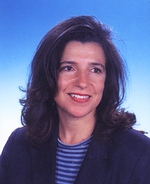 Eleni
Svoronou is responsible for the Capacity Building program of WWF
Greece. A major part of her work in the organisation is devoted to
ecotourism as a vehicle for nature conservation. More specifically her
work on ecotourism, for WWF, has included:
Eleni
Svoronou is responsible for the Capacity Building program of WWF
Greece. A major part of her work in the organisation is devoted to
ecotourism as a vehicle for nature conservation. More specifically her
work on ecotourism, for WWF, has included:
