'Ecos' of the Twin Lakes: Ecotourism Development in Mwaam (Muanenguba),
Cameroon
by Ivo Melle
Researcher, London Metropolitan University
ngwes76 [at] yahoo.co.uk
Abstract
West Central African montane forest
destinations are more famous as biodiversity hotspots or
centres for western scientific expeditions (with undetected
ecotourism). This paper is part of a pioneering initiative to profile ecotourism as it develops in Muanenguba, a mountain area in the south west of Cameroon.
It is the outcome of a fieldwork process which can best be
described as ‘being native’ by cooperating with frontline
host actors to track visitors and capture ecotourism
practices. The study discovers that the visitors –
predominantly highly educated professionals, travel groups made of friends and families –
are eco-friendly due to their backgrounds and respect for
the scenic splendours of the destination. They also embrace
both modern convenience and local tradition because the
hosts, Bakossi villagers and other accommodation providers have,
without realising it, taken
a key aspect of their culture - the traditional house - Ndab
Echum - to the visitors. Other interesting findings comprise
the relevance of visitor opinions and proven action in
identifying ecotourists, visitor interest in both dominant
trip activities and ethical initiatives as well as less
common travel motivations such as ‘ambiance’.
Cameroon and Muanenguba
 Based
on language and development potential, a TV documentary
assessed Cameroon as ‘a global player at the periphery of
mainstream society’. Despite its
label as an ecotourism paradise by some visitors, Cameroon
received just 451,000 tourists in 2006, still short of the
objective of 500000 to qualify as a developed tourism
destination by WTO standards (Okole, 2008). Cameroon
represents Africa in miniature. From the forested, coastal
south and southeast to the sahelian north, Cameroon presents
every visitor with diversity in natural (forests, mountains,
lakes, tropical rivers, climates) and cultural
attractions (folklore, enduring kingdoms, elaborate festivals, tales)
created by over 200 ethnic groups. There are also hotels of
international standard, golf courses, colonial relics and a
diversity of ecological and wildlife sanctuaries. These
resources offer various opportunities for different types of
tourism. Regarding the current situation, Behrens (2005)
expresses confidence that the wide range of natural and
cultural attractions illustrates Cameroon’s ecotourism potential. However, state incapacity, centralization and
lack of an effective national strategy for tourism
constitute retarding issues. Based
on language and development potential, a TV documentary
assessed Cameroon as ‘a global player at the periphery of
mainstream society’. Despite its
label as an ecotourism paradise by some visitors, Cameroon
received just 451,000 tourists in 2006, still short of the
objective of 500000 to qualify as a developed tourism
destination by WTO standards (Okole, 2008). Cameroon
represents Africa in miniature. From the forested, coastal
south and southeast to the sahelian north, Cameroon presents
every visitor with diversity in natural (forests, mountains,
lakes, tropical rivers, climates) and cultural
attractions (folklore, enduring kingdoms, elaborate festivals, tales)
created by over 200 ethnic groups. There are also hotels of
international standard, golf courses, colonial relics and a
diversity of ecological and wildlife sanctuaries. These
resources offer various opportunities for different types of
tourism. Regarding the current situation, Behrens (2005)
expresses confidence that the wide range of natural and
cultural attractions illustrates Cameroon’s ecotourism potential. However, state incapacity, centralization and
lack of an effective national strategy for tourism
constitute retarding issues.
Muanenguba (4° 40’ to
5° 15’ N and 9° 36’ to 9° 70’ E) is a stratovolcano
straddling the South West and Littoral Provinces of Cameroon
(part of the West Cameroon Mountain Line). It occupies the
northern part of the tribal Bakossiland and covers an area
of about 25 square km. The current
destination/summit area of Muanenguba, traditionally called
Mwaam (1950-2411m above sea level) – composed of the
picturesque/concentric Ebwo Caldera and Twin Lakes, the
principal attractions, is the product of
polygenic vulcanicity which occurred between 156-56 million
years ago (Dongmo et al., 2003). Mwaam is rich in
traditional history, awe-inspiring geology and scenic
splendours. Its romantic setting, the open, airy, tranquil,
naturally clean caldera floor, the beckoning character of
the Ebwo and Alehngum Peaks, and the ‘glorious views’ , as
described by a visitor, of the famous Twin Lakes,
which show an amazing contrast in colour (female-green and
blue-male), all adorned by the picturesque enclosure of the
rim of the caldera, add to the sense of an extraordinarily
elegant destination, a welcome escape to peace and quiet. Mwaam is a destination that distinguishes a genuine
nature-based tourist motivated by the need for a
‘contrast to everyday life’ (Mehemettoglu, 2007:111).
Lucky visitors to Mwaam are welcomed by the sight of moving
schools of fish (at 200m) as soon as they stand by the
concrete rest huts (buckaroos) and look down the steep-sided
crater of the Female lake. Some visitors venture down to the
female lake, explore the accessible northern shores and
enjoy a thrilling swim through the transparent and shallow
waters where crowns of aquatic plants (fish habitats) peep
through the lake floor. Although the social set-up of the
Bakossiland has been historically affected by globalization
(initially through Colonialism & Christianity), modernization and insitu
traditional changes, the peasant/village communities, Bakossi
peoples-the custodians, limited to fleeting contact with the
visitors, are still rooted through reliance on ‘their
holders of mbwog’, traditional bastions such as clan
sanctuaries and sacred societies. In respect of the ethereality of Mwaam,
local people consider Mwaam to be
their cradle: their ‘ancestors living in the Lakes’. They
have reintroduced two purpose-built traditional lodges (Ndab
Echum) on the northern accessible shores of the female lake
in order to ‘symbolize [their] custodianship of Mwaam’. This
essentially and effectively has transformed into a process
of attaching tradition to nature – taking a product or
taking ‘culture to the visitor’. Visitors appreciate this
indigenous initiative. Tourism in Mwaam is managed by the Bangem
Rural Council (BRC).
 Fieldwork Method Fieldwork Method
This research note follows six months of
field work (January to June 2007) during the dry or tourism
season which lasts November to May.
In a process best referred to as
being "sensibly native", the investigator manipulated his
"son-of-the soil" status. In this regard, he cooperated with
main actors (hoteliers and national security officials) in
order to track visitors. This was through access point
registration and in participation access point-generated
guide research trips. By so doing, visitors were guided
during destination tours, interviewed, and ethically
monitored. In effect, the visitor referred to by indigenes
as nkale, became the locally-preferred
nkinmut (the
interactive/accompanied stranger).
Ecotourism features
Old records reveal that
tourism in the Bakossiland and Muanenguba (Mwaam) is a
century old (German Colonial Society, 1906) but currently
still premature and not formalized. Evidence that Mwaam is
developing as a tourism destination are contained in the
following findings:
Tourism occurs in, but is not
strictly limited to, the dry season: November to April. The
peak period is December to April, during which 80.1% of all
visitors arrive, privileged by tropical montane weather.
Most visitors to Muanenguba are people of working age
(77.3%), predominantly highly educated professionals (about
80%-graduates and postgraduates) from Western Europe and
expatriates working in Cameroon, motivated mainly by love of
nature and culture. Visitors come from 33 countries. But
France – former colonial master – is by far the principal
supplier of visitors (57.3%). Arrivals are concentrated in Mwaam (the
destination) and at the Ekom Nkam Falls where visitors
stop-by. Demographic data also shows a male dominance of
13% contributed by sole male travellers and an apparent
balance of married and single visitors (about 40% and about
39% respectively), etc.
Using data on motivation,
the study identified 'Holidaymakers' as 51.5% of the
total, general interest tourists who enjoy visiting
countries, people in Africa and famous places for various
experiences, unconventionally including ‘ambiance’ (pride –
about 14%), 'self-confessed and proven Ecotourists' as 46.6%,
'proven hard-core Ecotourists' about 10%, adventure
travellers, family visitors, exchange visitors, business and
conference trippers.
|
|
|
|
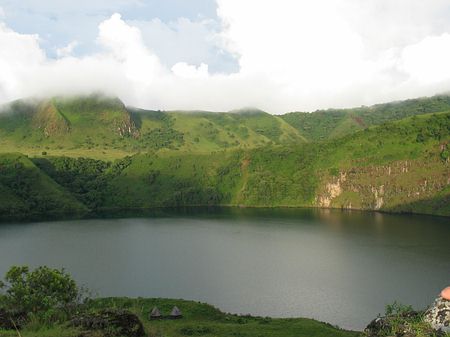
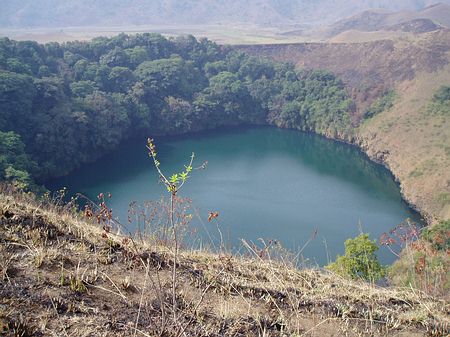
The glorious views of the Twin Lakes of
Muanenguba in Mwaan, the Female and the Male. Above, the Female
Lake or Edep. Notice the two small Ndab Echum at the foreground,
magnified below (Source: The Max Experience, 2005)
|
Male Lake or Njumue: echoing the ancestors of
Bakossi
(photo by Ivo Ngwese)
|
|

|
Data also helped identify first-time visitors (73.8%), repeat visitors
- largely resident expatriates - (21.3%, average number of
visits being three) persuaded by the scenic splendours of Mwaam; day visitors (12.6%), staying over visitors (87.4%
staying for 2.5 days, with prevailing patterns of popular
activities during the period) and the dominance of small
groups (for 91.1% of the arrivals in Mwaam – averaging four
persons).
Data on the trip activities revealed both
dominant ecotourism/pleasure activities such as trekking
and, in particular, hill walking (77.6%-figure 3); the use
of binoculars and cameras for sightseeing and photography
(82.7%); safaris involving birds around Mwaam, amphibians in
swampy parts of Ebwo, etc, and birds and free-range animals
around the villages (63.3%), as well as camping (44.0%) and
ethical initiatives e.g. dealing with waste (94.5%); seeking
permission to carry out some activities (43.6%); suggesting
correctives (7.7%); detesting non-ethical elements (49%);
and carrying out voluntary activities (15.3%). Visitors
extolled many more delightful (adventure and cultural) trip
activities than popular activities.
 Visitors use a mix of
locally-owned accommodation facilities such as ‘modern
traditional lodges’- small hotel establishments that contain
traditional houses (ndab echum), the two ndab echum by the
Female Lake or tents brought along with them. Interestingly,
some ethical visitors kept ‘an open mind’ due to a dilemma
as to what kind of accommodation they prefer, ready to
embrace what the destination presents. Visitors use a mix of
locally-owned accommodation facilities such as ‘modern
traditional lodges’- small hotel establishments that contain
traditional houses (ndab echum), the two ndab echum by the
Female Lake or tents brought along with them. Interestingly,
some ethical visitors kept ‘an open mind’ due to a dilemma
as to what kind of accommodation they prefer, ready to
embrace what the destination presents.
Tour operators are largely absent in Muanenguba.
Most respondents (76.7%) organize their trips themselves
with information from trusted friends and family members.
Travel freedom, viability, experience and ‘easy [and
independent] decision-making’ were the most important
factors given by the more forthcoming visitors. It was
fascinating to note that 6.8% of all visitors who enjoy
‘friendship and cooperation with locals’, organized their
trips with local accommodation establishments and villagers.
This tallied with the indigene-cherished interactive
visitor, nkinmut.
Due to limited villager/indigenous
participation, the benefits of ecotourism in Muanenguba are
to a large extent limited to the frontline actors. These
benefits comprise access and photography fees for councils,
visitor payments for accommodation (modern traditional
lodges) and wages for tourism employees – hoteliers, guides
and destination workers. Only anecdotal evidence exists for
wider community benefits, e.g. from the petit sale of
firewood in villages and the sale of some fruits, food and
snack items at road-side spots (carrefours).
From
the perspective of the visitors, the image of Mwaam is not
undermined by premature tourism dynamics: the scenic
splendours of Mwaam and life-changing experiences during
fleeting interactions with some indigenes eclipse any
service and logistical limitations. The future is certain
for aspects of tourism in Muanenguba such as an increase
in arrivals, the presence and diligence of the enlightened
visitor and male dominance.
Recommendations
Due to the premature level of
development, there is ample opportunity for ecotourism in
Muanenguba. A useful first step will be to create a local
Ecotourism Committee comprised of village representatives to work with
the Bangem Rural Council (BRC) in order to manage community-based ecotourism.
Committees are an existing norm for small development
projects in the villages of the region.
There is
a need to increase visitors’ experiences through creation of
heritage trails, forest walkways, designation of well-known
locations where animals can easily be sited e.g. Ebwo Peak
for bird watching, as well as provision of related
information. As suggested by visitors more concrete
structures should be avoided. The visitors like traditional
attachment to nature at the destination. Therefore more
traditional houses need to be constructed at the destination
and in villages en route.
There is also a need to
develop the nkinmut concept in Muanenguba. This is by
developing services and programmes that increase interaction
between visitors and hosts, such as
festivals during the peak period.
References
Behrens, J. 2005 “The Potential for
Ecotourism in Cameroon-a stakeholder analysis” in Thomas J.
Lichtenberg (ed.) 2005 Beiträge zum Nachhaltigen Tourismus,
Schriftenreihe der Fachhochschule Eberswalde. Berlin: Mensch
& Buch Verlag.
Dongmo A. k.; Wandji P.; Pouclet A.; Vicat
J.-P.; Cheilletz A.; Nkouathio D.G.; Alexandrov P.; Tchoua
F.M. 2001 “Volcanological Evolution of the Mount Manengouba
(Cameroon line), New Petrographical, Geochemical, and
Geochronological Data”,
Comptes Rendus de l'Academie des Sciences Series IIA Earth
and Planetary Science, 333(3). Paris: Elsevier SAS,
pp155-162.
German Colonial Society (1906) Atlas
German Colonies, with Yearbook: Retrospective on Kamerun’s
Development in 1905. Retrieved December 23, 2007 from
http://www.zum.de/psm/imperialism/kolonialatlas06/atlas13e.php
Mehmetoglu M. 2007 “Nature-based Tourism: A Contrast to
Everyday Life” , Journal of Ecotourism, Vol. 6 (2), pp111-126.
Okole, S. O. (2008) Tourisme: Les Perspectives pour
2008. Retrieved 1st April, 2008 from
http://www.bonaberi.com/article.php?aid=3447

|


 View all comments
 What
is your view?
What
is your view?